

 Through the inspired Word of God—the Bible—God calls the New Covenant Jew to do two things constituted by his or her particular Jewish identity: revere and obey the revealed words of God as contained in Scripture, and support and strengthen the Church with unique and irrevocable gifts. The New Covenant Jew (NCJ) is a baptized Jew, and most notably a Hebrew Catholic (Catholic Jew) fulfilled in grace within the one, holy, Catholic, and apostolic Church. As such, the NCJ is part of the remnant Israel of God (Rom 11:5, 9:27), the root of the Church (Rom 11:17-18), the People of God. The Church or People of God, then, consists of Jews faithful to משיח (Mashiach/Christ), Jews currently apart from Christ who will be faithful to Him or whose descendants will be (Rom 11:23-25)—constituting part of “all Israel” (Rom 11:26)—and the Gentiles of the People of God (Rom 11:11, 25). The two-fold calling of the NCJ is divinely graced as a special charism. We find the first inspired part of the calling referenced in the Epistle of Saint Paul to the Rom 2:12-13, 17-24 and 3:1-3, the Book of Isaiah 43:9-13, 44:1-3, 6-9, 48:17-19 and Deuteronomy 31:24-30, 32:1-4, 15-21. For example, in Romans 3:2, St. Paul tells us—in the wording of the Aramaic Peshitta and the original Greek text (ἐπιστεύθησαν)—that God entrusted the Jews/Israelites with His revealed words, that Jews might revere them as knowledge and truth, e.g., Rom 2:20, and obey them, e.g., Rom 2:21, 2:13, and 1 Cor 7:19.
The NCJ is a faithful steward of the revealed words of God, sometimes translated in Scripture (such as in the RSV Catholic Edition and the NRSV) as the “oracles” of God. “Paul” is Saul’s Greco-Roman name; it is not a conversion name. “Saul” was his Hebrew name, the name the risen Jesus “Adonai” used when He talked to him in Hebrew, e.g., Acts 9:4, 22:7, 26:14. Paul was a circumcised Hebrew/Israelite and Pharisee from the Tribe of Benjamin (Phil 3:5). He states in Romans 3:2, at least in part to Jewish disciples of Christ, that in every way there is much advantage to the Jew and value to circumcision.
The first and only cited reason for this advantage in this part of Romans is that “the Jews are entrusted with the oracles of God.” The implicit reason, presented in Romans 2:25-29, that “Circumcision, to be sure, has value…,” is that it signals the requirement of fidelity to all of God’s Torah, including the Commandments of love, the foundational mitzvot/expressions of love (cf. 2:17-23), with the essential internal disposition of faithfulness (Rom 2:28-29, Deut 30:6, Jer 4:4, Deut 6:4-5).
Circumcision, the Old Testament Abrahamic/Israelite sign of faithfulness to God’s covenant, and representational symbol of Mosaic precepts—though unnecessary for salvation, per se—is substantive to the calling of the New Covenant Jew. As explained in Romans 2, in allusion to Jeremiah 4:4, circumcision, and relevant Pentateuchal/Mosaic precepts—271 mitzvot that apply today or 297 that apply today in the land of Israel—aid the well-disposed NCJ by eliciting greater knowledge of God and loving faithfulness to Him. [2] Jesus Christ, the eternal Word and great Prophet-like-unto-Moses (Deut 18:15-18), is the source of the Torah and the mitzvot, and therefore is the interpreter and arbiter of its content. Moreover, Old Testament festivals, and by implication other Mosaic ceremonial precepts, all sustaining intrinsic value as ordained by YHWH, are “shadows” of heavenly realities centered on Christ (See for example Col 2:16-17 and Heb 8:4-5). Textually ordered Mitzva #516, referencing Deuteronomy 18:15, requires this allegiance to the great Prophet Messiah and therefore to hierarchical priority in assessing and systematizing the mitzvot.
The Jews, known in the Bible as Israelites—originally from the Hebrew Tribe of Abraham—did receive the revealed words, with which they were entrusted. First and foremost among the words are the Ten Commandments (called “Ten Words”) הדברות עשרת (Exod 34:28, Deut 4:13, 10:4) of love (Exod 20:6, Deut 5:10) on Mount Sinai, spoken directly by God Himself to the entire Israelite assembly (Exod 20:22, Deut 5:22-24), and then carved by YHWH Himself on tablets of stone. The revealed words of God are the following: the Ten Commandments—all of which are moral absolutes—and other laws of Moses directly associated with them, including the Two Great Commandments that summarize them (Deut 6:4-5, Lev 19:18, Matt 22:37-40); prophetic words inspired by the Holy Spirit; and provisional ceremonial, purificatory, dietary, and judicial precepts. Jesus Christ—YHWH the Son of God and the great Prophet like Moses of whom Moses spoke and to Whom is required resolute obedience—clarified, fulfilled, and explained these words of God in Sacred Scripture, Sacred Tradition, and Sacred Teaching Authority. Sacred Teaching Authority, or the Magisterium, interprets the other two which comprise the deposit of Faith. This deposit of Faith is transmitted through the one Catholic Church, founded by Jesus the Messiah as the perpetuation and fulfillment of Israel and inclusion of the Gentile People of God as one Mystical Body of Christ, of which He is Head.
The risen Christ, as the Head of the Church, along with His Mother Mary, the Mother of the Church, epitomize faithfulness to these fundamental expressions of love. Both Jesus, God Incarnate, and Mary, His first disciple, are risen and glorious, and both are Jews. Logically, Jesus and Mary, both alive forevermore, represent and live fulfilled, authentic Judaism. For this reason, when people reference the Jews and Judaism, Jesus, Mary, Joseph, the Church’s first saints, and all New Covenant Jews should be at the fore, distinguished from other types of Old Covenant Jews, e.g., Rabbinic Jews, Karaite Jews, and Ethiopian Jews, for whom we have respect and great hope! God’s promises to the Israel of God, i.e., the Jewish people—the standard of which is the NCJ—are fulfilled in every way by our faithful God (cf. Rom 9:4-5, 11:1, 29), including the promise of land (e.g., among numerous examples, Gen 17:7-8, Acts 7:2-5) and its eternal analogue (Heb 11:8-9, 12:22), the heavenly Jerusalem and heaven itself, the ultimate promised land.
Inspired by such great examples of holiness above, the NCJ is faithful to the Commandments of love. The will to obey the Commandments, through the theological virtue of charity, is the completion of justification (CCC, 1991, 1995), and acts of obedience to God’s will preserve and strengthen our justification, e.g., see Trent VI.7, 10, and Romans 2:13: “For it is not the hearers of the law who are righteous before God, but the doers of the law who will be justified.” (“Law” here means Torah—within this context of Romans it refers to all Biblical Mosaic mitzvot, with particular emphasis on Commandments of love, and exclusively these Commandments for Gentiles). In the Catechism of the Catholic Church (CCC, 1995) and Council of Trent (Trent, VI.7, 10), faithful acts of love are our sanctification and cause further growth of justification. Moreover, Paul implies that a Jewish disciple of Christ ought to be a trainer-guide-light of these Commandments for those in darkness (Rom 2:20).
The Old Testament, or Miqra (an ancient designation of the OT as a “reading,” as well as a designation of an assembly) also enjoins the Jew of the New Covenant to revere and obey the Commandments of love. The second calling of the Hebrew Catholic, explained below, addresses this.
The second calling of the NCJ is to support and strengthen the Church (Rom 11:18) with unique and irrevocable gifts (Rom 11:29). In Romans 9:2-5, Paul identifies gifts of Israel’s past, though he does not in this passage directly identify gifts by which a NCJ supports and strengthens the Church. However, the Book of Isaiah, in allusion to Deuteronomy, does indeed identify gifts of the Israelite, and of the future Israelite/Jew of the New Covenant.
Specifically, these gifts are knowledge of God, and praise of His mitzvot and great deeds of justice and mercy throughout salvation history (Isa 43:10-21, 44:8 and its allusion to Deut 31:9-13, 24-32:1-47). This history includes, for a NCJ, the call to witness to Jesus the Messiah and to His bestowal of the Holy Spirit (Isa 43:10, 18-21, 44:1-5, 55:3b-5; 61:1-3; 59:20-21).
In Romans 11, Paul addresses the relation and dynamic among the remnant of Israel, the salvation of the Gentiles, and the call of Israel. Israel and the Church are intricately and organically related: Israel is the root of the Church (Rom 11:18). Judaism, therefore, is not a religion “other” than Christianity, but is its core. Judaism in the Second Temple period, first referenced Ioudaismos ( Ἰουδαϊσμός, the Jewish faith or way of the Jews) in 2 Maccabees 8:1 and later in Galatians 1:13-14, was messianically oriented and substantially open to the revelation of fulfillment of the Jews in Christ. However, this original, pristine nature of Judaism, depicted at least among elements of the Essenes and Pharisees—even spanning certain theological diversifications—is both consonant with and yet divergent from subsequent Rabbinic perpetuation and reinterpretation of Judaism.
Fulfilled Judaism—pure Judaism—is New Covenant Judaism. Many other types of Judaism, e.g., Rabbinic and Karaite, are incomplete, although God calls their members to complete fulfillment in the Catholic Church. Among those who respond to YHWH’s grace, their fulfillment or that of their descendants will contribute to that glorious Day when all Israel will be saved (Rom 11:26).
For Luke, like Matthew (Matt 5:17-20), Jesus not only is not contrary to Judaism, He fulfills it: as the “glory of Israel (Luke 2:32),” Jesus is Torah in Person (Luke 2:32 in allusion to Isaiah 2:3, 5). [3] For John also, Jesus is the King of Israel (John 1:49-50); for Mark, He is the great Jewish Messiah, Son of the Blessed One (Mark 14:61). According to Saint Paul, Israel/Judaism is the root of the Church (e.g., see Rom 11:16-20). Again, Judaism is the core of Christianity, not a different religion.
In Isaiah 43, YHWH foretells the downfall of Babylon and deliverance of Israel from Babylonian captivity. In God’s omniscient will, generally, and concerning the future, specifically, He proclaims to Israelites: “You are My witnesses, My servants whom I have chosen” (Isaiah 43:10). Then the Lord explains that which they are to witness:
To know and believe in Me and understand that I am He. Before Me no God was formed, nor shall there be any after Me. I Am, I Am YHWH, and beside Me there is no savior. I revealed, saved, and proclaimed, when there was no strange god among you, and you are my witnesses, declares YHWH, that I am God. Yes, from eternity I Am He. There is none who can deliver from My hand. (Isa 43:10-13)
Israelites/Jews are to witness to God’s eternal existence and salvific power. God is the Eternal One, with no beginning, no end. YHWH’s sacred disclosure of His identity to Moses at the burning bush, and its eternal significance, is one of many examples of God’s revelation to His people Israel in which to know, believe, and understand His transcendent divinity.
The Jew also is to witness to the praise of His mitzvot, and to His great deeds of justice and mercy throughout salvation history. Acts 1:8 reflects an intense apex of this divine calling from Jesus the risen Lord: “But you will receive power when the Holy Spirit comes upon you, and you will be my witnesses in Jerusalem, throughout Judea and Samaria, and to the ends of the earth!” In Isaiah 43:20-21, God enjoins His chosen people, whom He chose for Himself, to declare His praise. Of what does that praise consist? The Hebrew words used here, “They may proclaim My praise” יספרו תהלתי refer to proclaiming God’s glory. In the immediate context (Isaiah 43:15-17), God is referring to His glory reflected in the following: A) the creation of Israel in the calling of Abraham and Sarah and the other Patriarchs and Matriarchs, and in His establishment of Israel as a nation at Sinai through the Mosaic covenant and stipulations of love—the Ten Words and other mitzvot; B) His dramatically powerful liberation of the Israelites from slavery in Egypt, and all of His just, merciful, salvific deeds of the past.
In the broader context of Isaiah, proclaiming God’s praise or glory refers to the wisdom, justice, and goodness of the mitzvot (see also Deut 4:6-8 on this point), and the future age of the Messiah and the Holy Spirit He bestows on His people. In Isaiah 44:8, as God continues speaking His Word through the Prophet Isaiah, He says to the Israelites, “You are My witnesses! Is there a God or any Rock besides Me? Idol makers all amount to nothing…” This alludes directly to Deut 32:4, 15, 18, and 30-31. Moses proclaims, about the Rock, Who created Israel (32:6), “…how right all His ways! A faithful God…” Deuteronomy 32, the Song of Moses and his final appeal and view of Canaan, immediately follows the completion of the recitation of the Ten Commandments, the Shema, and the code of Deuteronomy. In Isaiah 44:8, God’s self-reference as the “Rock” elicits, not only His eternity, omniscience, and saving power, but also the mitzvot that faithful Israelites keep. This connection is supported further in Isaiah 48:17-18, in which God proclaims to the Israelites that He teaches that which is for their good, the way they should go…His mitzvot. Those who know righteousness have the Torah/divine instruction at heart (Isa 51:7).
Finally, announcing God’s praise looks to the future Israelite, when he or she will see something new: a “way” in the desert, “water” in the desert to drink (Isaiah 43:19-20), God’s “Spirit” upon the offspring of Israelites (Isaiah 44:3); the Davidic Servant Messiah Who will restore the Tribes of Israel and be a Light to the nations and Covenant of the people (Isa 49:1-6, 42:1-7, 55:3-5), Who will teach and establish righteousness upon the earth, healing and liberating from evil, Who will suffer horrifically and die for the guilt of us all; the Spirit upon the Davidic Servant Messiah (Isa 42:1) Who ushers in the New Covenant, now poured out collectively among God’s people e.g., Isa 44:3-559:21, 61:1-3, Joel 3:1-5, including—in fulfillment of divine covenants and prophecies—the Gentiles! The Holy Spirit will internalize and empower an obedience to the Torah (Jer 31:31-33; Ezek 36:25-27) hitherto unknown!
In addition to obeying the Commandments of love and all mitzvot that apply today, and advocating for these Commandments in a world that often neglects or opposes them, how does the NCJ witness to God’s great deeds of justice and mercy throughout salvation history, including the great deed of the justice and mercy of Jesus Christ, the Incarnation of the eternal Son of God? The way to witness is the way God has pronounced and in which He has blessed the Israelite/Jew—to keep and engage in especially the Biblical but also traditional prayers, devotions, and festivals. The types and examples of these are too numerous to mention here, but they are a blessing and a serious call to witness powerfully, as we see from the inspired writings of Biblical Saints Paul and Isaiah, to mention only two. As discussed above, advocated in Scripture and concerning the well-disposed NCJ, following relevant Mosaic precepts and living the traditions arising from them elicit greater knowledge of God and faithfulness to Him. The Word does not mandate (and prohibits human judgment concerning engaging in mitzvot, cf. Col 2:16-17) but does call the NCJ to embrace faithfully this devotional and exacting, heightened moral life. The response and witness of the NCJ may be private or communal, such as in an Association of Hebrew Catholic Havurah.
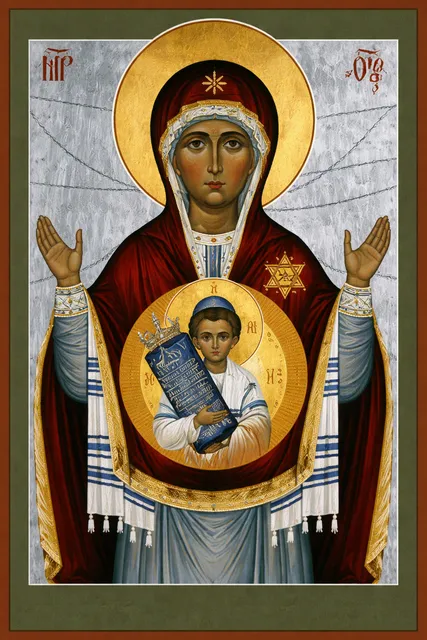
Speaking as a Hebrew Catholic, the NCJ is Spirit-led, then, to revere and obey the revealed words of God and strengthen the Church. The goal is always to glorify the Trinitarian God, within Whom we follow and love—fearlessly—our Messiah, Jesus, the eternally begotten Son. Our fidelity to the mitzvot, our prayers, devotions, and festivals—shadows of heavenly realities (cf. Heb 8:4)—are all about Him, not us. He is Immanuel, God-with-Us. Among the many saints we honor and emulate, who strengthen our love for Christ, we most especially devote ourselves to the humble, faithful, powerful one who brought our Savior into our beautiful but fallen world. This is the Jewish virgin alma, the New Eve and Queen Mother, the Blessed Virgin Mary.
Brother Gilbert Bloomer hits the bullseye: “The whole of Jewish spirituality is directed to Adoration of the Divine Presence; the revived Jewish Church of the Circumcision [within the Catholic Church] will be focused on the Adoration of the Divine Presence in the Eucharist.” God calls the NCJ to a serious, irreplaceable role within the Church. As Archbishop (now Cardinal) Burke remarked: “The Roman Catholic Church knows and treasures the particular and privileged part in the economy of salvation, assigned by God the Father to the people of Israel.”
Footnotes
[1] This article appropriates some relevant material, including verbatim, from an earlier article I wrote, “The calling of the Hebrew Catholic: rooted in and directed by the Word of God,” The Hebrew Catholic, Issue No. 113, Winter 2024.
[2] See Catholics for Israel, “The 613 Mitzvot (Jewish Commandments).”
[3] See also my dissertation on this point and several others in this article: The Septuagintal Isaian Use of Nomos in the Lukan Presentation Narrative.
[4] Br. Gilbert Bloomer, “Vocation of the People Israel,” The Hebrew Catholic: Shavuot—Pentecost , No. 112, Winter Spring 2023, p. 20.