

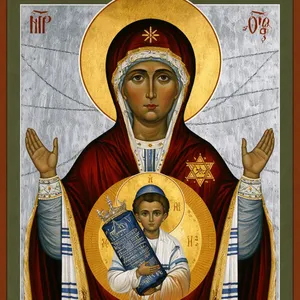
 What does it mean to be a Jew who follows Jesus the Messiah? Dr. Mark Koehne argues that Scripture itself discloses a divinely authorized, two-fold calling for the "New Covenant Jew": to revere and obey the revealed words of God, and to support and strengthen the Church with gifts that are unique and irrevocable. Drawing on Romans, Isaiah, and Deuteronomy, Koehne shows how the Hebrew Catholic stands not outside Judaism but at its fulfilled center—rooted in Israel's covenant, illumined by Christ.
Lire la suite : The Divinely Authorized Calling of the New Covenant Jew
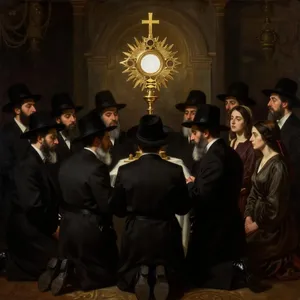 It is sometimes suggested, particularly by self-appointed "experts" in Jewish-Christian relations, that the Catholic Church has definitively resolved all questions concerning the validity of the Mosaic covenant and the place of Torah observance for Jews within the Church. Such confidence is unwarranted. While the Church has made decisive progress in rejecting anti-Judaism and articulating the permanence of God's election of Israel, she has not issued definitive rulings on several crucial questions relating specifically to Jewish believers in Christ.
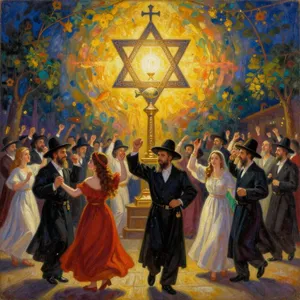 This article discusses a perennial theological question within Catholic theology: how can a Catholic speak meaningfully of continuity between the Law of Israel and the New Covenant in Christ without falling into Judaizing on the one hand, or supersessionist rupture on the other?
Lire la suite : Old Law and New Law: A Hebrew Catholic, Torah-Attentive, and Divine Will Perspective
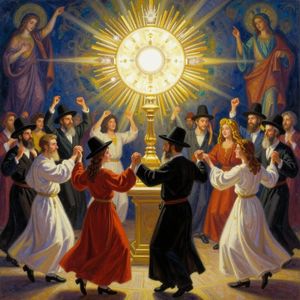 The Hebrew Catholic movement stands at a delicate but providential threshold. Emerging historically from the Hebrew Christian and missionary paradigms of the nineteenth and early twentieth centuries, it has gradually been forced to confront a deeper theological question: whether Jewish identity in Christ is merely instrumental to evangelisation, or whether it possesses intrinsic spiritual and ecclesial value within the mystery of the Church itself.
Lire la suite : Synagoga Restored: Toward a Messianic Hasidic Kehilla within the Catholic Church
 The Great Mystery (1863) by Rev. C. W. H. Pauli (Rabbi Tzvi Nassi) is a fascinating exploration of the Trinity through Jewish tradition. Written in autobiographical style, it reveals how the God of Israel manifests Himself as Three in One, drawing on the Hebrew Bible, the Targums, and the Zohar. A timeless work of Jewish‑Christian dialogue, now available for free download.
Lire la suite : FREE BOOK: The Great Mystery: How Can Three Be One?
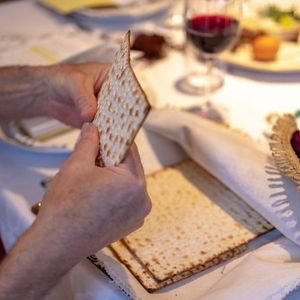 Do the sacramental rites of the Old Testament continue to have value after Calvary? This controversial question has been answered in very different ways in the history of the Church. In recent decades, there has been a widespread change of perspective due to many factors including the Holocaust, the Second Vatican Council's Nostra Aetate, the rejection of more radical forms of supersessionism, the spread of messianic Jewish congregations, and the practice of participation in the Passover seder in parishes.
 How are Catholic preachers supposed to reconcile the legitimation of military violence in Deuteronomy with the Gospel’s celebration of childlike meekness? If ignoring this dilemma is the option of cowards... contrasting the peaceful spirit of the New Testament with the violent teachings of the Old is theologically perilous.
Lire la suite : Childlike Innocence or Just War? Reconciling the New Testament with the Old
 In remaining true to the sources of Jewish tradition, Jews are commanded to avoid the madness that seizes society at various times and in many forms, while yet retaining a moral composure and psychological equilibrium sufficient to exercise that combination of discipline and charity that is the hallmark of Judaism.
Lire la suite : Judaism and the Modern Attitude to Homosexuality
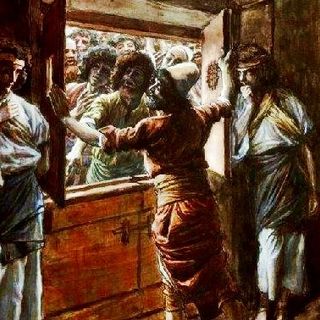 Parmi les perversions sexuelles interdites en tant que criminelles par le code moral de la Torah on trouve les relations homosexuelles entre hommes (Lv 18 ,22). La loi du Talmud étend cette condamnation aux lesbiennes. Des sources rabbiniques avancent diverses raisons à une stricte interdiction de l’homosexualité ; et de fait, cette interdiction est même considérée comme une loi universelle qui fait partie « des Sept Commandements de la Loi des Enfants de Noé »
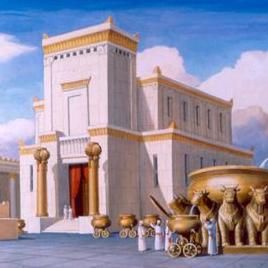 A Temple is a seat of Divine Presence. In Judaism, there are two Temples, one for the dimension of time, the Sabbath, and one for the dimension of space, the Temple in Jerusalem. Christianity adds a third, the Son of G-d incarnate in the nature of man.
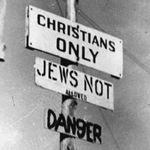 It seems to me that a Catholic cannot help but be a crass supersessionist unless he recognizes the value that keeping the Law of Moses can have for the Jew who would serve G-d as He revealed Himself through His Incarnate Son.
