


Originally published on Katnut D'Katnut (Feb 2, 2026). Reprinted by author's permission.
Introduction: The Question of Law and Fulfilment
Discussion following my essay "Open Questions on Jewish Observances" in 2010 raised a perennial theological question within Catholic theology: how can a Catholic speak meaningfully of continuity between the Law of Israel and the New Covenant in Christ without falling into Judaizing on the one hand, or supersessionist rupture on the other?
This question is not merely academic. It touches directly upon Scripture, Tradition, magisterial teaching, Jewish-Catholic relations, and the lived vocation of Catholics of Jewish origin. It also requires careful attention to the development of doctrine, lest earlier formulations be misread in isolation from the Church's deepening biblical and theological understanding. This blog post essay is a revision and development of one I wrote back in 2010.
This question arises not in abstraction but in lived ecclesial experience. Catholics of Jewish origin often find themselves navigating a complex spiritual terrain: drawn by baptism into the fullness of Catholic communion, yet marked irrevocably by the covenantal identity of Israel. For such believers, questions of Torah observance are not ideological provocations but matters of conscience, fidelity, and vocation. Too often, pastoral responses oscillate between two inadequate poles: either discouraging any Jewish practice for fear of "confusing the faithful," or encouraging a purely symbolic retention of heritage emptied of covenantal meaning.
Neither approach does justice to the reality of grace at work in the lives of Hebrew Catholics, nor to the Church's own teaching on the irrevocability of God's gifts and calling (Rom 11:29). A genuinely pastoral approach must therefore be discerning rather than prohibitive, attentive to intention rather than mere form, and rooted in the Church's long tradition of differentiating between obligation, devotion, custom, and vocation.
The question presses us to reconsider how Law and Gospel are related within the economy of salvation. If the New Covenant is understood merely as a replacement of the Old, continuity collapses into rupture; yet if continuity is affirmed without transformation, the messianic novelty of Christ is obscured. The Catholic tradition, especially as developed through Newman's doctrine of development and renewed biblical theology in the twentieth century, offers a more integrated vision: the Law is neither abolished nor frozen, but fulfilled through interiorisation, eschatological depth, and participation in the divine life.
From a Divine Will perspective, this fulfilment is not only moral or juridical but ontological: the Law finds its deepest meaning when human obedience is taken up into God's own eternal Fiat. In this light, Torah observance by Jews within the Church can be understood not as a regression to a pre-Christian state, but as a particular form of covenantal fidelity now lived in Christ, ordered to sanctification, and oriented toward the ultimate restoration of all things. Such a vision allows the Church to uphold unity without uniformity, continuity without confusion, and fulfilment without erasure - a vision urgently needed for both theological clarity and pastoral charity today.
One Law of God, Two Modes of Relation
The starting point must be a fundamental clarification: there is only one Law of God, but there are distinct covenantal modes of relating to that Law. As Cardinal Jean-Marie Lustiger repeatedly emphasised, the so-called "Old Law" and "New Law" are not two competing moral systems. Rather, they describe two historical and spiritual modes of participation in the same divine will:
- the Law lived in promise, prior to the Messiah;
- the Law lived in fulfilment, in the Messiah.
In this sense, the "newness" of the New Law does not consist in novelty of content but in messianic depth, interiorisation, and eschatological fulfilment. This is fully consonant with biblical Judaism itself, which anticipates a "new Torah" in the days of the Messiah - not a different Torah, but a Torah understood from within divine intimacy.
From a pastoral perspective, the affirmation of one Law of God lived in two covenantal modes offers a crucial key for accompaniment and discernment. It allows the Church to avoid the false alternatives that often trouble both Jewish and Gentile believers: either that fidelity to the Torah must be relinquished upon entering the New Covenant, or that fidelity to Christ requires the imposition of uniform practices upon all. Instead, this framework recognises that God's will is singular, while human participation in it unfolds historically, vocally, and personally.
For Hebrew Catholics in particular, this distinction provides the theological space to live their baptism not as a rupture with Israel but as a deepening of Israel's own covenantal vocation. Pastoral care, therefore, must be attentive to intention, formation, and ecclesial communion, guiding such believers to integrate inherited practices into a Christ-centred life without confusion or coercion, and always within the obedience of faith.
The distinction between promise and fulfilment illuminates the inner dynamism of revelation itself. The Law, as given at Sinai, is already ordered toward communion with God, yet its full depth becomes accessible only in the Messiah, who embodies and interiorises it. The "newness" introduced by Christ is thus not legislative replacement but ontological transformation: obedience is no longer primarily external conformity but participatory alignment with the divine life.
From a Divine Will perspective, this transformation reaches its apex when human acts are drawn into God's eternal act, such that the Law is lived from within the Fiatrather than merely under it. This accords with the Jewish expectation of a renewed Torah in the messianic age, understood not as innovation but as unveiled intimacy. In Christ, the Torah is no longer encountered solely as command but as communion, and this communion, while one in essence, is embodied differently according to covenantal calling, state of life, and grace.
Galatians and the Question of Judaizing
Objections frequently cite St Paul's Letter to the Galatians, particularly passages such as Galatians 3:7, 3:16, 3:29, and 6:12-18. Yet these texts must be read in their historical and pastoral context. Galatians is addressed to Gentile believers, not to Jews. Paul's concern is not Jewish Torah observance per se, but the claim that Gentiles must assume Jewish covenantal obligations as a condition of salvation. This position - whether advanced by Jewish or Gentile teachers - is what the Church has historically meant by Judaizing in its problematic sense.
Contemporary Pauline scholarship, including the "New Perspective on Paul," has helped recover Paul's Jewish identity and covenantal logic. Paul is not attacking the Torah as the Word of God; he is opposing its misuse as a boundary marker excluding Gentiles from grace.
From a pastoral standpoint, confusion surrounding Galatians has often caused unnecessary anxiety, particularly for Catholics of Jewish origin who desire to live their faith with integrity. When Galatians is read abstracted from its concrete audience and historical situation, it can appear to condemn any form of Torah observance outright. This has led some pastors and catechists, often with good intentions, to discourage Jewish Catholics from even cultural or devotional expressions of Jewish life, out of fear of undermining justification by grace.
Such an approach, however, misunderstands Paul's pastoral aim. Paul is not addressing Jews who believe in the Messiah and continue to live as Jews; he is confronting Gentile believers who are being told that salvation requires them to cross a covenantal boundary that God Himself has not imposed. A pastorally sound reading of Galatians therefore liberates rather than constrains: it protects Gentile freedom in Christ without negating Jewish vocation within the Church.
Galatians reveals Paul's profound covenantal reasoning rather than an opposition between Law and Gospel. Paul assumes the goodness of the Torah as divine gift, yet insists that its role within salvation history must be properly located. The Torah was never intended to function as an ethnic or juridical gatekeeper to grace; its purpose is pedagogical, covenantal, and ultimately messianic. In opposing the use of Torah observance as a salvific boundary, Paul is defending the universal scope of the Abrahamic promise, now unveiled in Christ.
From a Divine Will perspective, this distinction becomes even clearer: the problem is not Torah observance itself, but observance detached from the interior participation in God's salvific act. When Torah is lived as covenantal response within the Messiah, it no longer functions as exclusion but as communion. Galatians, read in this light, does not undermine the Law's sanctity; it situates it within its true telos, where obedience is no longer a marker of separation but a participation in the divine life offered freely to Jew and Gentile alike.
"An Eye for an Eye": Law, Justice, and Misuse
Similarly, Jesus' teaching on "an eye for an eye" must be read carefully. The l ex talionis (the law of retaliation) in Torah functions as a judicial principle limiting retaliation, not as licence for personal vengeance. Jesus does not reject the Law as unjust; rather, He challenges its privatisation and abuse. Christ's teaching restores the Law to its true intention by drawing it inward, purifying its application, and revealing its deepest telos: merciful justice grounded in divine love.
Misunderstanding Jesus' words on "an eye for an eye" has often led to a distorted view of the Old Testament Law, as though it were intrinsically harsh and in need of moral correction by the Gospel. This caricature can foster an implicit anti-Jewish reading of Scripture and obscure the pastoral wisdom embedded in the Torah itself. The lex talionis functioned originally as a restraint on violence, limiting retribution and placing justice within the authority of the community rather than the passions of the individual.
In pastoral practice today, Jesus' teaching calls believers to examine not only their actions but their interior dispositions: the impulse to justify resentment, to baptise retaliation with moral language, or to weaponise Scripture in defence of one's own wounded pride. Christ's words are thus not an abolition of justice but a summons to relinquish self-authorised judgement and to entrust justice to God, the lawful order of society, and the redemptive logic of mercy.
Jesus' interpretation of the lex talionis exemplifies the messianic interiorisation of the Law rather than its negation. By drawing the Law inward, Christ reveals its ultimate orientation toward communion rather than control. Justice, in this light, is not merely proportional recompense but restoration of right relationship - between persons, within the community, and ultimately between humanity and God.
From a Divine Will perspective, this movement inward reflects a profound ontological shift: the Law is no longer encountered solely as an external norm regulating behaviour, but as an invitation to align one's will with the divine Fiatitself. Mercy does not replace justice; it fulfils it by restoring the Law's deepest purpose. Thus, Christ's teaching unveils the Torah's inner heart, where obedience becomes participation in divine love and justice is transfigured into an act of redemptive fidelity that heals rather than merely restrains.
Benedict XIV and the Observance of Ceremonial Rites
Pope Benedict XIV's 1756 encyclical Ex Quo is frequently cited in discussions of Torah observance. When read in context and in harmony with the development of doctrine, it proves remarkably nuanced. Benedict XIV affirms that observing rites resembling those of the Old Law does not in itself constitute Judaizing, provided such observance is not undertaken:
- as an obligation of the abrogated legal regime,
- as necessary for salvation,
- or in opposition to the authority of the Church.
He explicitly allows such observance when done:
- by personal devotion,
- by human custom,
- or under ecclesial instruction.
Crucially, Benedict XIV is addressing Gentile Catholics, not Jewish Catholics. If Gentiles may observe Jewish rites as custom or devotion, a fortiori Jews within the Church may retain the practices of their own people - provided they do so within the New Covenant intention.
Ex Quo offers an important framework for discernment rather than a rigid prohibition. Benedict XIV's careful distinctions allow pastors to move beyond reflexive suspicion toward practices that resemble Jewish ritual, and instead to ask more substantive questions: Why is this practice being observed? With what intention? Under whose authority and within what ecclesial context?
This approach is particularly significant for Catholics of Jewish origin, for whom certain observances are not adopted as novelties or private experiments, but received as part of a living inheritance. Pastoral care shaped by Ex Quo can therefore affirm legitimate expressions of Jewish continuity while safeguarding against confusion about salvation, obligation, or ecclesial unity. It allows room for formation, guidance, and obedience, rather than demanding cultural erasure as a condition of Catholic fidelity.
Benedict XIV's reasoning presupposes a sacramental and incarnational understanding of human action and custom. Ceremonial practices are not neutral in themselves; their meaning is determined by intention, covenantal context, and ecclesial location. When rites formerly associated with the Old Law are observed outside the salvific framework of obligation and re-situated within the New Covenant, they undergo a transformation of meaning rather than simple repetition.
From a Divine Will perspective, this transformation is decisive: the same external act, once inserted into the messianic economy, participates in a different ontological order. What was once preparatory becomes participatory; what was once anticipatory becomes eucharistically oriented. In this light, Benedict XIV's allowance is not a concession to sentiment, but a recognition that divine pedagogy works through continuity as well as fulfilment. The Law's ceremonial forms are not abolished as empty shells, but transfigured when lived within Christ and under the Church's authority, revealing the depth of a covenant that is not discarded but brought to its intended completion.
Who Is a Judaizer?
A critical distinction must be made between two kinds of Judaizing:
- Gentile Judaizing: the claim that Gentiles must observe Jewish Torah obligations as necessary for salvation.
- Jewish Judaizing: the claim that Jews must impose those obligations upon Gentiles.
Neither applies to Torah-attentive Hebrew Catholics who observe mitzvot not as salvific necessity, but as covenantal fidelity lived within the Messiah.
From a practical pastoral perspective, failure to distinguish properly between these two forms of Judaizing has caused significant confusion and, at times, genuine harm. Torah-attentive Hebrew Catholics are often suspected of Judaizing simply because they retain Jewish practices, even when these are lived in explicit communion with the Church and with clear New Covenant intention. Such suspicion usually arises from an unexamined assumption that any visible continuity with Jewish observance must imply a rejection of grace or a denial of Christ's sufficiency.
Yet pastoral discernment requires attention not to external form alone, but to intention, catechetical formation, and ecclesial obedience. Torah observance becomes pastorally problematic only when it is presented as salvifically necessary for others, or when it undermines the Church's teaching on justification by grace. Where neither is the case, the charge of Judaizing is misplaced and risks confusing legitimate vocation with doctrinal error.
At a deeper theological level, the distinction clarifies the Church's perennial concern: not the Law as gift, but the Law as boundary wrongly absolutised. Both forms of Judaizing identified above share a common error - transforming a covenantal calling particular to Israel into a universal condition of salvation. This error is precisely what St Paul resists, not because the Torah lacks divine origin, but because salvation in Christ transcends ethnic and juridical boundaries while still honouring them within God's providential economy.
From a Divine Will perspective, this becomes even clearer: the problem is not observance, but observance detached from participation in the divine Fiat. When mitzvotare lived as covenantal fidelity within the Messiah - ordered to communion, not exclusion - they no longer function as instruments of separation but as modes of sanctification proper to a specific calling. In this light, Torah-attentive Hebrew Catholics are not Judaizers, but witnesses to the mystery that unity in Christ does not require the erasure of Israel's vocation, only its transfiguration within the fullness of grace.
Covenant, Abrogation, and Renewal
When Benedict XIV speaks of the Law being "abrogated," this must be understood precisely. What is abrogated is the obligation of Gentiles to assume Jewish covenantal observances, as articulated in Acts 15 - not the Sinai Covenant itself. This interpretation is confirmed magisterially by Joseph Ratzinger (later Benedict XVI), who wrote:
"The Last Supper sees itself as making a covenant: it is the prolongation of the Sinai covenant, which is not abrogated, but renewed."
(Many Religions, One Covenant, p. 62)
Thus, abrogation refers to juridical obligation for Gentiles, not covenantal invalidation for Israel. Clarity on the meaning of "abrogation" is essential to prevent both confusion and unnecessary anxiety among the faithful. When the term is used imprecisely, it can give the impression that God has revoked His covenant with Israel, thereby fostering either triumphalism on the Christian side or alienation on the Jewish side.
Pastoral teaching must therefore distinguish carefully between juridical obligation and covenantal vocation. Acts 15 addresses a concrete ecclesial question: whether Gentile converts are required to enter Israel's covenantal obligations in order to be saved. The apostolic decision to dispense Gentiles from such obligations safeguards the universality of the Gospel, but it does not imply that Jewish believers are required to abandon the covenantal forms through which their fidelity has historically been expressed. A pastorally responsible approach will therefore affirm Gentile freedom in Christ while recognising that Jewish Catholics may live their discipleship through inherited forms of covenantal obedience, provided these are integrated within the New Covenant and lived in communion with the Church.
The distinction between abrogation and renewal reflects the inner logic of salvation history itself. Covenants in Scripture are not replaced in the manner of superseded contracts; rather, they are taken up, intensified, and re-expressed within a higher unity. Joseph Ratzinger's insight that the Last Supper prolongs the Sinai covenant rather than abolishing it is decisive here. The New Covenant does not negate Sinai but unveils its deepest meaning by drawing it into the self-gift of the Son.
From a Divine Will perspective, this renewal signifies not merely continuity of law, but continuity of divine intention: the same Fiat that spoke at Sinai now speaks from within human flesh and human obedience. The Law is no longer encountered solely as an external norm but as a covenantal relationship interiorised in Christ. Thus, what is set aside is not Israel's covenantal bond, but the requirement that Gentiles enter that bond juridically. Israel's covenantal calling remains, now illuminated and transfigured by the Messiah, while the nations are grafted in by grace - one economy of salvation, one divine will, expressed through differentiated yet harmonised forms of covenantal life.
The Irrevocability of the Covenant
St John Paul II taught unequivocally that the Old Covenant is irrevocable. This teaching is reflected in the Catechism of the Catholic Church (121):
"The Old Testament is an indispensable part of Sacred Scripture… for the Old Covenant has never been revoked."
Statements such as those formerly included in the USCCB Catechism - affirming the enduring validity of the Mosaic covenant for Jews - were not doctrinally incorrect but pastorally misunderstood. They refer to sanctification and vocation, not to parallel paths of salvation. There is one salvation, in Christ, by grace; yet there remain distinct covenantal callings within salvation history.
From a practical pastoral standpoint, the Church's affirmation of the irrevocability of the covenant is crucial for healing historical wounds and for forming consciences rightly. When Catholics are taught, implicitly or explicitly, that God has "cancelled" His covenant with Israel, this not only distorts Scripture but undermines trust in God's faithfulness itself. Pastoral clarity is therefore essential: affirming the enduring covenantal vocation of the Jewish people does not weaken Christological faith, nor does it imply two parallel ways of salvation.
Rather, it safeguards the integrity of God's promises and helps Jewish-Catholic dialogue move beyond suspicion and caricature. For Catholics of Jewish origin, this teaching provides a stable theological foundation for living their baptism without feeling compelled to repudiate their inherited identity. It reassures them that fidelity to Christ does not require amnesia regarding Israel, but discernment, formation, and ecclesial communion.
The irrevocability of the covenant flows directly from the nature of God's self-giving in history. Divine covenants are not provisional contracts subject to cancellation, but acts of election rooted in God's eternal will. As St Paul insists, "the gifts and the calling of God are irrevocable" (Rom 11:29), a statement the Church has increasingly recognised as foundational rather than peripheral.
From a Divine Will perspective, this irrevocability is not merely historical but ontological: the covenantal relationship established with Israel remains inscribed within salvation history as a permanent dimension of God's redemptive plan. What changes with the coming of Christ is not the covenant's validity, but its horizon - now opened to universal fulfilment. Sanctification and vocation continue to unfold within differentiated callings, yet all are gathered into the one salvific economy centred on Christ. Thus, the Church can confess with full clarity that there is one salvation by grace in the Messiah, while also honouring the enduring covenantal identity of Israel as integral - not incidental - to the mystery of redemption itself.
Jewish Observance in the New Covenant
For Jewish Catholics, Torah observance is not a return to a pre-Christian mode, but a messianic transfiguration of Jewish life. Observances are undertaken with:
- Eucharistic intention,
- Marian depth,
- and explicit confession of Jesus as Messiah and Lord.
Acts 21 attests that Jewish believers in Jerusalem remained "zealous for the Torah" after Pentecost. This is not a contradiction of the Gospel but a sign of its Jewish fullness.
Jewish observance within the New Covenant must be understood as a vocation to integration rather than duplication or nostalgia. For Jewish Catholics, practices such as Sabbath rhythms, the liturgical calendar, dietary disciplines, and blessings are not undertaken as attempts to "recreate" a pre-Christian Judaism, nor as private experiments in spirituality. Rather, they are lived as inherited forms of fidelity now consciously oriented toward Christ and fully embedded within sacramental life.
Pastoral accompaniment must therefore focus on formation and intention: ensuring that such observance flows from Eucharistic communion, remains obedient to ecclesial authority, and is clearly distinguished from any claim of salvific necessity. When guided wisely, Jewish observance can deepen rather than confuse faith, strengthening family life, prayer, and moral coherence, and offering the wider Church a lived reminder of her own Jewish roots.
Jewish observance in the New Covenant reveals the inner logic of fulfilment itself. Acts 21 is decisive: the apostles do not instruct Jewish believers to abandon the Torah after Pentecost; instead, they recognise their continued zeal as compatible with full communion in Christ. This continuity points to a messianic transfiguration rather than a juridical rupture. From a Divine Will perspective, Torah observance becomes a mode of participating in Christ's own obedient life, now interiorised and universalised through grace.
The mitzvot, lived within the Messiah, are no longer anticipatory signs but responsive acts - human gestures taken up into the eternal Fiat . Eucharistic intention situates all observance within Christ's self-offering; Marian depth shapes it by receptivity and fiat; and explicit confession of Jesus as Lord anchors it unequivocally in the New Covenant. In this way, Jewish observance does not compete with the Gospel but manifests its Jewish fullness, bearing witness that the Messiah has not erased Israel's vocation, but drawn it into its deepest, most luminous fulfilment.
Divine Will and the Interiorisation of Torah
From the perspective of the Divine Will, as articulated by Luisa Piccarreta, the Law reaches its deepest fulfilment not in external observance alone but in interior participation in God's eternal Fiat. Torah observance, when lived in the Divine Will, becomes not merely ethical or ritual, but cosmic and redemptive, reintegrating human acts into God's eternal act. This represents not regression but eschatological advance.
The teaching on the Divine Will offers a crucial corrective to both legalism and spiritual abstraction. Many faithful struggle to integrate concrete religious practices with interior freedom: some fear that observance inevitably leads to rigidity, while others reduce spirituality to intention divorced from embodied action. Luisa Piccarreta's insight reframes this tension by insisting that what matters most is not the multiplication of external acts, but the mode in which they are lived.
For Jewish Catholics attentive to Torah, this is especially significant. Practices inherited from Israel are not to be performed as autonomous religious achievements, nor as nostalgic markers of identity, but as acts consciously surrendered to God's Will and united to Christ's own obedience. Pastoral accompaniment, therefore, must emphasise interior disposition, Eucharistic grounding, and humility, helping the faithful discern whether an observance is drawing the soul more deeply into divine intimacy or subtly recentring it upon the self.
The Divine Will reveals the Law's ultimate horizon as participatory rather than merely prescriptive. In Luisa's writings, Jesus repeatedly distinguishes between doing the will of God and living in the Will of God - the latter involving a real insertion of human acts into God's eternal act. When Torah observance is lived within this horizon, it is no longer confined to historical repetition or moral regulation; it becomes eschatological. Human obedience is taken up into the Fiatthat created, redeemed, and will consummate all things.
From this perspective, mitzvotlived in the Divine Will participate in cosmic restoration (tikkun), not as parallel salvific works, but as grace-enabled cooperation in Christ's redemptive economy. The Law thus reaches its deepest fulfilment not by being set aside, but by being interiorised, universalised, and elevated - so that even the smallest human act, offered within the Divine Will, resonates beyond time and contributes to the restoration of creation "as it was in the beginning."
Toward an Observant Hebrew Catholic Community
Opposition to Torah-attentive Hebrew Catholics exists both within Catholic and Jewish communities. Yet notable Jewish thinkers, such as Michael Wyschogrod, recognised the theological coherence of Jewish observance within the Church and supported its legitimacy.
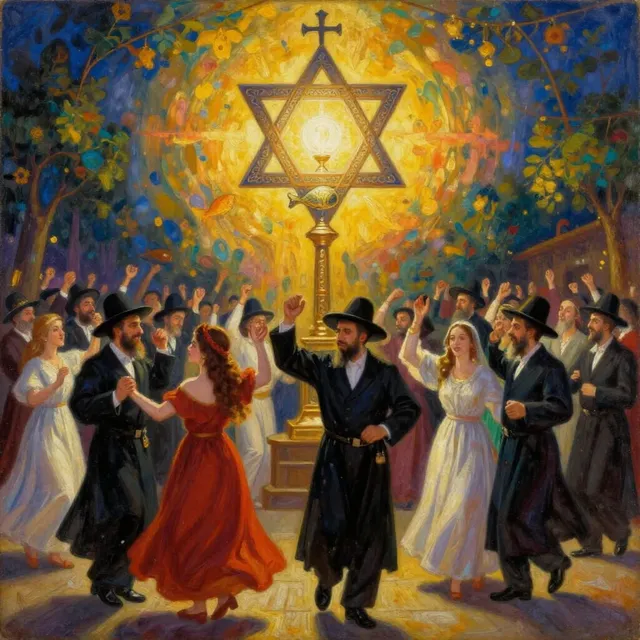
The Church should actively encourage Catholics of Jewish origin to embrace their heritage as a gift to the whole Body of Christ. Such communities may require patience and time - perhaps generations - to be fully received, just as Hasidism itself was once marginal.
The emergence of an observant Hebrew Catholic community requires patience, humility, and sustained ecclesial accompaniment. Such communities inevitably find themselves navigating suspicion from multiple directions: within the Church, concerns about confusion, division, or regression; within the Jewish world, fears of betrayal, assimilation, or proselytism. Pastoral leadership must therefore resist both defensiveness and haste.
The task is not to force recognition or to demand immediate institutional resolution, but to cultivate stable, obedient, well-formed communities whose fidelity to Christ is unmistakable and whose Jewish observance is transparent in intention and charity. Over time, the fruit of such communities - strong family life, liturgical reverence, moral seriousness, and prayer rooted in Scripture - will speak more persuasively than polemics. History suggests that authentic spiritual movements are rarely received quickly; they are tested, purified, and slowly recognised through endurance.
The gradual emergence of an observant Hebrew Catholic presence reflects the Church's own eschatological structure. The Body of Christ is not a flattened uniformity but a differentiated unity, in which distinct vocations serve the whole according to God's providential ordering. Michael Wyschogrod's insight is especially significant here: he recognised that Jewish embodiment, covenantal practice, and fidelity to mitzvotbelong intrinsically to Israel's election and need not be negated by faith in Christ.
From a Divine Will perspective, such a community may be understood as a sign of convergence rather than conflict - a locus where Israel's historical vocation and the Church's universal mission begin to overlap without coercion or erasure. Just as Hasidism required generations to move from marginal suspicion to recognised legitimacy within Judaism, so too an observant Hebrew Catholic community may mature slowly as a prophetic sign. Its ultimate purpose is not self-assertion, but service: to witness, quietly and faithfully, that the Messiah has not dissolved Israel's calling but is bringing it, through time and grace, to its deepest and most luminous fulfilment.
Conclusion: Hope and Eschatological Patience
Some old Catholic prophecies speak of a future in which Jews enter the Church without ceasing to be Jews. Hebrew Catholics do not seek to hasten or define this mystery, but to live faithfully within it. The Association of Hebrew Catholics has served as an important signpost toward this future: a Church more deeply rooted in Israel, and an Israel more fully opened to her Messiah. In the Divine Will, Law and Gospel are no longer opposed but unified; promise and fulfilment meet; and the Torah itself shines with its original light - now revealed in the face of Christ.
From a practical pastoral perspective, this posture of hope combined with eschatological patience is essential if the Church is to avoid both presumption and paralysis. Hebrew Catholics are not called to engineer outcomes, resolve centuries of tension, or force premature reconciliations between Church and Synagogue. Their vocation is quieter and more demanding: to live visibly faithful lives marked by sacramental communion, obedience to the Church, and reverent continuity with Israel's heritage.
In doing so, they bear a witness that is neither confrontational nor apologetic, but stable and enduring. Institutions such as the Association of Hebrew Catholics play an important pastoral role precisely because they resist isolation, provide formation, and model ecclesial belonging without cultural erasure. Their existence signals that the Church need not fear Jewish particularity, and that Jewish Catholics need not live their faith as a private anomaly rather than a shared vocation.
At a deeper theological level, this patient hope reflects the structure of God's own saving action in history. The reconciliation of Israel and the nations is not an event to be scheduled but a mystery to be awaited, prayed for, and prepared through fidelity. In the Divine Will, time itself is gathered into God's eternal act, and apparent delays are revealed as spaces of maturation rather than failure. Law and Gospel, promise and fulfilment, Israel and the Church are not resolved by negation but by convergence within Christ.
The Torah, lived in the Divine Will, shines not as a superseded relic but as a transfigured gift, its deepest intention unveiled in the obedient love of the Son. In this light, Hebrew Catholics may be understood as an eschatological sign - small, often hidden, but real - of a future unity that does not abolish difference but harmonises it. Such hope does not demand visibility or triumph; it rests instead in the confidence that the God who began His work with Israel will bring it to completion, in His time, through His Messiah, and according to His eternal Fiat.