

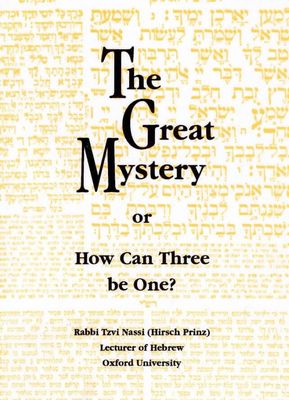
 We are pleased to present The Great Mystery; or, How Can Three Be One? by Rev. C. W. H. Pauli — also known by his Hebrew name Rabbi Tzvi Nassi — first published in London in 1863.
Pauli was a Jewish scholar who came to recognize that the God of Israel reveals Himself as Three Persons in One, and that Yeshua is the Messiah of Israel. Out of this conviction, he wrote The Great Mystery as a dialogue between Jewish tradition and Christian faith, showing how the Trinity is not a foreign concept but deeply rooted in the Hebrew Scriptures and ancient rabbinic writings.
Written in autobiographical style, Pauli speaks as “Nathanael,” an Israelite in search of divine truth, who discovers in the Aramaic Targums, the Sohar (Zohar), and other Jewish sources profound hints of the Triune God. Rather than a dry treatise, the book unfolds as a spiritual journey, inviting readers into the wonder of how “Three can be One.”
Outline of the Book
Preface
Pauli explains his purpose: to show that the doctrine of the Trinity was already present in Jewish tradition. He frames the book as autobiographical, presenting himself as “Nathanael,” an Israelite in pursuit of divine knowledge.
Part I: Nathanael’s Journey and Jewish Authorities
- Nathanael describes his spiritual struggles and thirst for truth.
- He consults both the Hebrew Bible and ancient Jewish teachers.
- Sketches of Jewish authorities:
- The Aramaic Targums on the Torah: Pauli draws on Targum Onkelos, Targum Pseudo‑Jonathan, and the Jerusalem Targum. These ancient paraphrases often speak of the "Word (Memra) of the Lord," which he interprets as evidence of God’s personal self‑manifestation.
- The Sohar (Zohar): Mystical text attributed to Simeon ben Jochai, revered for its insights into God’s nature.
- Sefer Yetzirah (Book of Creation): Ancient mystical text, sometimes attributed to Abraham.
- Grammatical observations: God often speaks in the plural in Scripture, suggesting plurality within the Godhead.
Part II: The God of Israel
- Examination of the divine name Elohim and its plural form.
- Rabbinic commentary (R. Bechai) interprets Elohim as “These are God.”
- The Zohar teaches of “Three steps in the Godhead” and “Three heads united in One.”
- Scriptural reflections on Deut. 6:4 (“Hear, O Israel, the Lord our God, the Lord is One”), interpreted as unity within plurality.
- Jewish mystical sources: references to the Shechinah, the “Middle Pillar” of the Godhead, and emanations of divine light.
Part III: The Word of the Lord and the Angel of the Covenant
Subdivided into four sections:
- The Word (Memra) of the Lord
- In the Targums, the “Word of the Lord” is depicted as Creator, Lawgiver, and covenant partner.
- The Angel of the Covenant
- Identified as an uncreated being, styled “YHWH Elohim” and “Adonai.”
- Seen as Redeemer and Mediator, embodying God’s presence.
- Metatron
- A mystical figure described as the “first begotten of God” and “Son of God.”
- Functions as mediator between God and humanity.
- The Son of God
- The “Middle Pillar” of the Godhead revealed as the eternal Son.
- Described as emanation of divine light, fountain of life, and object of faith.
Part IV: The Holy Spirit
- The Holy Spirit is presented as a substantive Being, Creator of the world, possessing divine attributes.
- Role of the Spirit: guide of Israel, sender of prophets, quickener of the dead.
- Concludes with an exhortation to recognize the Spirit’s role in salvation and to embrace the Triune God.
Why Read The Great Mystery?
- Jewish‑Christian dialogue: Highlights the continuity between Jewish sources and Christian faith.
- Accessible style: A personal quest rather than a dry treatise.
- Historical value: A 19th‑century Jewish scholar’s testimony to the mystery of the Triune God.
👉 View and download The Great Mystery (PDF)