

Source: doronkeidar.substack.com (October 9, 2026). Reprinted by permission.
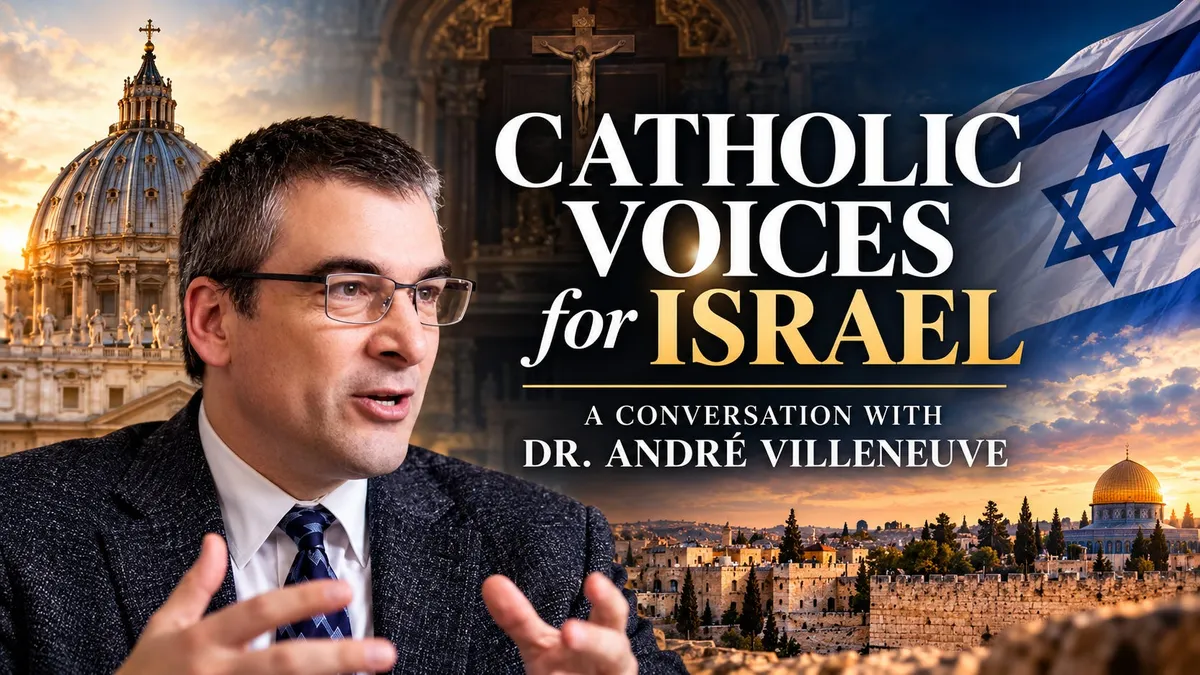
“Catholic Voices for Israel” sounds like a contradiction to a lot of people. That reaction is exactly the problem Dr. André Villeneuve has spent nearly two decades trying to correct.
Villeneuve is a theology professor at a Catholic seminary, a former evangelical who found his way back to Rome after years studying in Israel, and the founder of Catholics for Israel — an organization he started in 2007 as a PhD student at the Hebrew University of Jerusalem. Since October 7th, he’s become far more active, teaming up with Father Antoine Levy, a Dominican priest based in Jerusalem, to launch Catholic Voices for Israel. Their first major statement, “For Zion’s Sake: A Catholic Appeal in Support of Israel,” has gathered roughly 200 signatures so far.
I sat down with him to unpack something that gets flattened into soundbites constantly: what does the Catholic Church actually teach about Israel, Zionism, and the Jewish people — and how does that differ from what a handful of loud Catholic commentators claim on the Church’s behalf?
The Problem: Pundits Speaking as if They Were the Magisterium
Villeneuve’s frustration is specific. When the patriarchs and heads of churches in Jerusalem released a statement condemning Christian Zionism as a “damaging ideology,” a wave of Catholic commentators seized on it as confirmation that Rome rejects Zionism outright. He named names — Matt Fradd’s simplified “catechism” on Christian Zionism, commentary from other prominent Catholic voices — arguing that these takes treat centuries-old replacement theology as settled doctrine without actually engaging the theological argument.
The distinction he kept coming back to: there’s a difference between someone’s opinion and the magisterium — the Church’s official teaching office, meaning the Pope together with the bishops. Commentators are entitled to their views. They are not entitled to present those views as the Church’s position.
We also talked about how this bleeds into public figures using their faith as a credential. Without getting into any one individual’s motives, the broader pattern is familiar: someone invokes their Catholic identity to lend authority to sharply critical positions on Israel, and audiences walk away assuming that’s simply “what Catholics believe.” Villeneuve’s point is that faith and political opinion get merged in ways that misrepresent the institution — and that’s precisely the gap Catholic Voices for Israel exists to close.
Three Sources, Not One
To understand why this is a slower fight than it might seem, Villeneuve laid out the basic architecture of Catholic theology. Evangelical Christianity generally operates on sola scriptura — scripture alone. It’s simple and direct, but it also means there’s no central arbiter, which is part of why Protestantism has splintered into so many denominations.
Catholic theology works differently. Revelation comes through three channels: sacred scripture, sacred tradition, and the magisterium. The Church’s own teaching is that scripture remains “the soul of sacred theology” — Villeneuve calls it prima scriptura, scripture first, rather than scripture only — but tradition and official teaching also carry weight.
That has real consequences. He pointed to a widely circulated reference to Pope Pius X’s 1904 meeting with Theodor Herzl, where the Pope reportedly told Herzl the Church could not support Zionism because the Jewish people had not recognized Christ. It’s a popular talking point among Catholic anti-Zionists. But as Villeneuve noted, that account comes from Herzl’s private diary, not from any Church document — it was a private conversation, carrying no doctrinal authority whatsoever.
His actual conclusion is more careful than either side of the debate usually allows: the Catholic Church does not have an official theology of Zionism — not for it, and, contrary to what its critics claim, not officially against it either. Since the Second Vatican Council’s Nostra Aetate in the 1960s, the Church has explicitly repudiated replacement theology and antisemitism, affirming — quoting Romans 11 — that “the gifts and the calling of God are irrevocable.” What’s still missing, in his view, is the next step: an explicit affirmation that the modern return of the Jewish people to the land is itself a sign of God’s faithfulness.
Two Kinds of Ignorance
Villeneuve identified two separate obstacles among Catholics on this question, and they require different remedies.
The first is straightforward biblical illiteracy — commentators who rarely cite scripture outside the Gospels, ignoring that three-quarters of the Catholic Bible sits before Matthew. He leaned on St. Jerome’s line that “ignorance of scripture is ignorance of Christ,” and pointed out that the prophetic books he teaches every year are saturated with promises of Israel’s return to the land, running from Deuteronomy through Ezekiel and beyond.
The second is more subtle: allegorization. Even Catholics who know their scripture will spiritualize every promise of the land into a metaphor for heaven, treating the Church as the “New Israel” that supersedes the promises made to the Jewish people. Villeneuve doesn’t reject typological reading outright — Catholic hermeneutics does allow multiple layers of interpretation — but he insists the literal sense has to be the starting point, and a spiritual reading doesn’t cancel it out. His reference point is Christ’s own words: “I have not come to abolish but to fulfill.”
Tradition, Capital-T and Lowercase-t
On the historical record of Catholic-Jewish relations, Villeneuve didn’t sand down the hard parts. Replacement theology runs deep in the Church Fathers, and it fed centuries of anti-Jewish legislation and, at times, violence. But he drew a sharp line between attitudes that were widespread and doctrine that was official — a distinction he frames as capital-T Tradition (binding and authoritative) versus lowercase-t traditions (more like customs, closer to what Judaism calls minhagim). The anti-Jewish theological commentary of past centuries, he argued, was never canonized by an ecumenical council or taught ex cathedra by a Pope.
He also pushed back on the instinct to treat isolated bad actors — a hostile rabbi, an inflammatory pastor — as representative of an entire tradition, whether that’s Judaism, Catholicism, or evangelical Christianity. Individual reaction, shaped by real historical grievance, isn’t the same as institutional teaching, and collapsing the two only deepens division.
Jesus’s Jewishness Isn’t Incidental
We spent time on why Christ’s Jewish identity — son of David, son of Abraham, Isaac, and Jacob — matters theologically rather than just historically. Villeneuve’s framing: if the Messiah is returning as the Davidic king to reign from Jerusalem, that’s not a detail you can spiritualize away without changing what’s actually being claimed. The last question Jesus’s own disciples asked him was about the restoration of the kingdom to Israel.
His analogy for Catholics who claim to love Jesus while remaining indifferent to Judaism: it’s like falling in love with someone from another country and declaring you have no interest in their language, family, or history. It doesn’t hold together. Understanding Christ’s Jewish humanity — his prayers, his cultural world — requires actually engaging with that identity rather than treating it as a footnote.
On eschatology specifically — the mechanics of the End Times, the millennium, how literally to read prophetic timelines — Villeneuve was notably more restrained than on the historical and doctrinal questions. The Catholic Church has never dogmatized a single eschatological framework, and he sees real value in that humility. He drew a comparison to the Jewish approach: study these things closely, prepare to recognize the signs, but resist the urge to lock in a rigid, falsifiable prediction the way dispensationalist frameworks — the “Left Behind” model, for instance — tend to do.
Holding Israel to an Impossible Standard
Toward the end of the conversation, we turned to a familiar move in anti-Zionist rhetoric: demanding that modern Israel meet a standard of holiness before its claim to the land is taken seriously — often paired with theories questioning whether contemporary Jews are even genealogically connected to biblical Israel.
Villeneuve’s response leaned on a fairly simple observation from scripture itself: biblical Israel was rarely holy. From the golden calf through the era of the Judges, through the divided kingdom and exile, the nation’s history is one of recurring failure, offset by “a small remnant of the righteous.” The story the Bible actually tells isn’t primarily about Israel’s faithfulness — it’s about God’s. That framing, he argued, should reshape how Christians evaluate the modern state: legitimate criticism of specific policies or conduct is fair game, but it’s a separate question from whether the covenant and the promises still stand. Israel’s imperfection was never the precondition for the promise.
We also touched briefly on his own time living in Israel as a Christian — direct experience that, in his account, stood in sharp contrast to some of the more sweeping claims of systematic Christian persecution that circulate online. He didn’t dismiss the real incidents that do occur, but placed them against the backdrop of a broader Israeli public and civil society actively working against that kind of extremism.
The Bigger Picture
What struck me most in this conversation wasn’t a call to make every Christian a Zionist. Villeneuve was explicit that he doesn’t expect that, and isn’t offended when people land elsewhere. What he’s after is narrower and, I’d argue, more important: that when someone claims to speak for the Catholic Church on Israel, that claim should actually be checked against what the Church has said — not against what’s politically convenient or theologically inherited without examination.
In a media environment where a handful of loud voices get treated as representative of entire traditions, that kind of precision matters. Villeneuve and Father Levy aren’t asking Catholics to adopt a political position. They’re asking them to read the sources before repeating the talking points.