

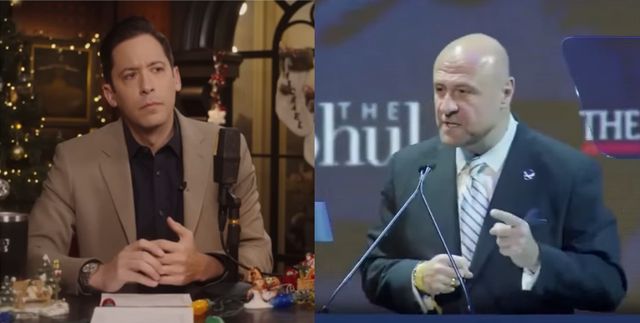
Michael Knowles should be commended for supporting the state of Israel based on international law. But when he lampoons Robert Stearns for his version of Christian Zionism, he misrepresents both Stearns and Catholic teaching.
Knowles defines Christian Zionism as a "niche Protestant trend . . . the nationalist ideology that arose in the 19 th century and sought to return Jews to the Holy Land" and alleges that Stearns believes that the modern state "is of biblical and prophetic necessity."
But Knowles gets all these things wrong. Christian Zionism, which is the Christian idea that God brought the Jews back to the land which He promised them, is as old as the New Testament. Rather than being exclusively Protestant, it was held in various versions by some of the Church Fathers and has been recently endorsed by the Vatican, a canonized pope, and distinguished Catholic theologians.
In the Miami speech which Knowles cites, Stearns actually distanced himself from those who say that Jews and Israel are necessary for the apocalypse. It was something of a joke, and Knowles missed the punchline.
In other words, Stearns is not a dispensationalist, and Knowles confuses all Christian Zionists with dispensationalists. Classic dispensationalism is focused on an unbiblical "rapture" that makes Christ's final coming a third rather than second coming, treats the Jewish people as "earthly" and on a separate track to the eschaton, and revels in detailed End-Times schedules that go beyond what the Bible tells us.
Christian Zionism started with the New Testament. In his last major statement on the Jewish people more than twenty-five years after his conversion, Paul said these Jesus-rejecting brothers "are [note the present tense] beloved because of the fathers," the patriarchs. Their "gifts and calling are irrevocable" (Rom 11:28-29).
"Calling" was a technical Jewish term for God's choosing Abraham's seed to be his Chosen People, and "gifts" for first-century Jews like Philo the Alexandrian philosopher and Josephus the historian always included the land promise (where God promised to Abraham and his progeny "all the land of Canaan for an everlasting possession" Gen 17:8). This land promise is repeated in the Old Testament one thousand times.
Many think that Jesus implicitly denied the land promise when He preached in the Sermon on the Mount, "Blessed are the meek, for they shall inherit the earth" (Matt 5:5; my emphasis). But scholars (such as here and here and here ) are starting to recognize that Jesus was quoting Psalm 37:11, and that the Hebrew word for "earth" can also be translated as "land." Since the phrase "inherit the land" occurs five times in Psalm 37, it is probable that Jesus meant "land" and not "earth."
Lest there be doubt that Paul still believed in the land promise, Luke tells us in Acts of the Apostles that when preaching in a synagogue in Antioch of Pisidia (now Turkey), Paul told his audience that "after destroying seven nations in the land of Canaan, God gave this people Israel their land as an inheritance" (Acts 13:16b-17, 19). This was more than twenty years after his Damascus road encounter, and Paul could not have been more explicit that he continued to hold to the land promise.
But it wasn't only Jesus and Paul. The author of Hebrews says God led Abraham to a placeto receive as an inheritance, and that Isaac and Jacob were heirs with him of the same promise (Heb 11:9). Before his martyrdom, deacon Stephen said God promisedto give Abraham this land as a possession and to his offspring after him (Acts 7:4-5).
Then there is St. Peter's prophecy in his second speech in Jerusalem that the apokatastasisis still to come (Acts 3:21).This was the word used by the (Greek language) Septuagint (the Bible for the early church) that one day there would be a return to the land by Jews from the four corners of the earth (Jeremiah 16:15; 24:6; 50:19; Hosea 11:11).
Many scholars said these Old Testament prophecies referred to the return to the land after exile in Babylon. But Peter was speaking after the resurrection of Christ. He was predicting a future worldwide return to the land-which did not occur in significant numbers for more than seventeen centuries.
Some of the Church Fathers taught elements of the Christian Zionist hope. Justin Martyr said the millennium will be centered in Jerusalem, Irenaeus taught that Israel will one day be restored, and Tertullian declared that Jews will return to the land to restore their polity. Fourth-century historian Eusebius of Caesarea reports that third-century Egyptian bishop Nepos taught the restoration of Israel and that his writings were "most convincing" to others. The Testament of the Twelve Patriarchsis a second-century document that teaches the future restoration of the twelve tribes and reflects early Church teaching by thinkers who clearly rejected replacement theology-the idea that God replaced Jews with Christians and hence the land is no longer holy.
Knowles cherry-picks Vatican and papal teaching when he claims that Zionism is alien to the Vatican. In the 2015 document "The Gifts and the Calling of God Are Irrevocable," the Vatican Dicastery for Promoting Christian Unity pays tribute to "the continued love of God for the chosen people of Israel." In 1991, Pope John Paul II referred to the return of Jews to the "mountains of Israel" in the last centuries as a fulfillment of Ezekiel's promise in 34:13.
English Catholic theologian Gavin D'Costa sees in recent magisterial documents a trajectory toward a "minimalist Catholic Zionism" whose building blocks are the assertions that "the Jewish covenant is irrevocable; that this covenant applies to the Jews today; that part of this covenant has been the promise of the land; that this promise is not superseded or annulled in the New Testament and is firmly based in the Old Testament."
It is always dangerous to rely on secondary sources, and Knowles should know that. But in his article denouncing Stearns for watering down Christian orthodoxy, he accuses Stearns of saying it is "irrelevant" if Jesus was the Messiah. Knowles took that from an "AF post." But Stearns said no such thing; it is absent from the transcript.
Then Knowles charges Stearns with violating the law of contradiction when he said "Yes" to the question of whether Jesus' future coming to Jerusalem (Acts 1:11; Luke 13:35) would be his first or second. For those with ears to hear, Stearns meant what many Catholic preachers have said-it would be his first coming for many Jews and his second for those already converted.
Stearns' "Yes" violates the law of contradiction only if a Yes to these two questions also so violates: 1) Is God one or three? and 2) Is Jesus God or man?
Finally, Knowles shows a bit of historical ignorance when he criticizes Stearns for apologizing to Jews for the centuries of Christian persecution of Jews. Was Saint Pope John Paul II wrong to ask at his Day of Pardon Mass in 2000 for God's forgiveness for the sins and "errors" committed by Christians over the past 2,000 years, specifically mentioning the "wrongs inflicted on Jews"? Was Pope Benedict XVI "accommodating" (as he says of Stearns) when in 2010 at the Great Synagogue of Rome he stated that the Church "deplored the failings of her sons and daughters, begging forgiveness for all that could in any way have contributed to the scourge of anti-Semitism and anti-Judaism"?
We are grateful that Knowles works with the great Ben Shapiro to further truth in a world that has exploded with antisemitism. We hope, however, that Knowles thinks a bit more before he slanders a Christian brother whose teaching is closer to Catholic teaching than he imagines.