

God's Love for You: The Gospel of Jesus the Messiah
The World Around Us
Every human heart longs for happiness and love. This deep desire—present in you and in me—is universal and unshakable.
The beauty of the world around us awakens a yearning for something more. We’re moved by the goodness of those we love, and fascinated by the mystery of humanity, which so often reflects truth, beauty, and goodness.
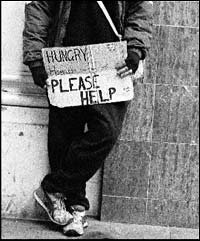
Yet alongside this beauty, we see a world deeply wounded. Poverty, illness, injustice, selfishness, anger, violence, and despair surround us. Life can easily become filled with fear, loneliness, pain, hopelessness and confusion.
Many try to escape this harsh reality through artificial paradises—drugs, alcohol, fleeting relationships—but these only deepen our pain and alienation. Others seek comfort in genuinely good things: music, entertainment, sports, hobbies, work, friends, and family. Yet deep down, we know that even these cannot fully satisfy our restless heart.
Can we make any sense of this world—so beautiful, yet so broken?
God's Love for Creation
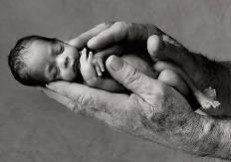
God, infinitely perfect and blessed in himself, in a plan of sheer goodness freely created man to make him share in his own blessed life. (CCC 1)
The good news is that God created the world* and everything in it - including you - out of infinite love. He is not just some impersonal force, but a personal God who knows you and loves you more than you could ever imagine. He knew you already while you were in your mother's womb:
For you created my inmost being; you knit me together in my mother's womb. (Ps 139:13)
He knows where you come from, where you've been, and where you're going. He also knows your thoughts, your hopes, your joys, your pains, and your fears:
O LORD, you have searched me and you know me. You know when I sit and when I rise; you perceive my thoughts from afar. You discern my going out and my lying down; you are familiar with all my ways. Before a word is on my tongue you know it completely, O LORD. (Ps 139:1-4)
God loves you with an infinite love, just as He loves every person in the world. He has a wonderful plan for your life: He created you to share in His own divine life of love (2 Pet 1:4), so that you may be happy with Him forever:
I have loved you with an everlasting love; Therefore with loving kindness I have drawn you. (Jer 31:3)
For I know the thoughts that I think toward you, says the LORD, thoughts of peace and not of evil, to give you a future and a hope. (Jer 29:11)
From the beginning of human history, God formed a covenant*—a sacred family bond—with the human family. Through this covenant, we are adopted as His children, loved and cared for. God calls each of us into this relationship: to share friendship with Him and with one another as His family, trusting and obeying Him in everything.
Our Freedom

God does not impose Himself upon us, and He does not force us to love Him. True love must always be a gift freely given. God made us free so that we could love Him and one another.
Our freedom is a great gift—but it also means we have the choice to receive God’s offer of life and love, or to reject it:
I call heaven and earth as witnesses today against you, that I have set before you life and death, blessing and cursing; therefore choose life, that both you and your descendants may live; that you may love the LORD your God, that you may obey His voice, and that you may cling to Him, for He is your life and the length of your days. (Deut 30:19-20)
God invites us to choose life—to love Him, to trust Him, and to walk with Him. But He will never force our hand. The choice is ours.
Sin
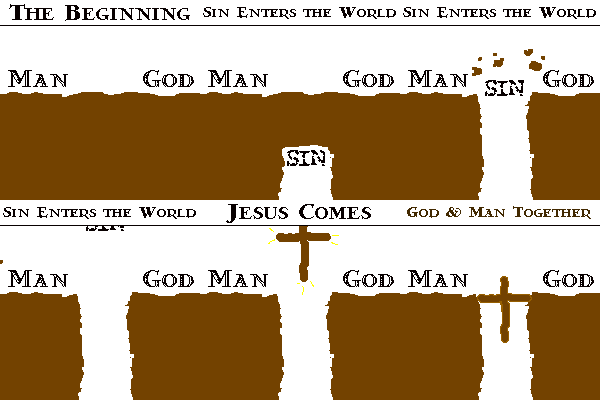
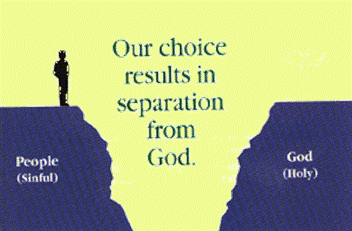 The bad news is that we have all broken God's covenant. Because we have the freedom to choose “not God,” sin* enters the world. Sin is the root of all the evil and suffering around us.
We sin when we turn away from God—away from His goodness and truth—and instead follow our own way. We act as we please, often selfishly, making wrong choices and living without God at the center of our lives. Sin breaks our relationship with God and separates us from His life.
The Bible reminds us of what we already know: that we have all sinned, rebelled, and turned away from God, each in our own way:

The LORD looks down from heaven on humankind to see if there are any who are wise, who seek after God. They have all gone astray, they are all alike perverse; there is no one who does good, no, not one. (Ps 14:2-3)
Behold, I was brought forth in iniquity; and in sin did my mother conceive me. (Ps 51:5)
For there is not a just man on earth who does good and does not sin. (Eccl 7:20)
All have sinned and fall short of the glory of God. (Rom 3:23)
Sin is not just a mistake—it’s a rupture in our relationship with the One who made us. And that rupture has consequences.
Death
The terrible consequence of sin is death (Rom 6:23). We often treat death as the normal and inevitable end of life. Yet deep down, we fear it—not just the end of our earthly existence, but the possibility of being eternally separated from the source of all love, joy, peace, and happiness.
We've lost sight of the fact that, in the beginning, God never intended death to be a part of human life. Still, each one of us longs for immortality. We dream of a life free from suffering, illness, and death—a life where we can enjoy the good things of the world without limit. And indeed, death is not our ultimate destiny. God has called us to life, life in all its fullness. It is only because of sin—our willful turning away from God—that death now reigns:

…but of the tree of the knowledge of good and evil you shall not eat, for in the day that you eat of it you shall surely die. (Gen 2:17)
Whoever has sinned against me I will blot out of my book. (Exod 32:33)
But your iniquities have separated you from God; and your sins have hidden His face from you, so that He will not hear. (Isa 59:2)
The soul that sins, it shall die. (Ezek 18:4)
Death is not just a biological event—it is the spiritual consequence of separation from God.
Bridging the Gap
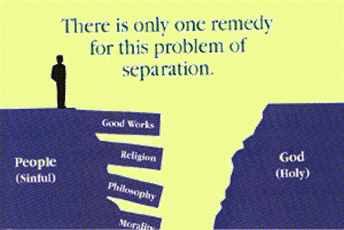
 Whether we believe in God or not, most of us feel the weight of suffering and death looming over our fragile lives. We bury ourselves in activity—trying to find peace, to "make things right" with God and others, to soothe our conscience, to leave a mark in this brief life. We may pursue popularity, wealth, or power; seek fulfillment through learning, creativity, or acts of mercy; or turn to philosophy, meditation, or religion.
But no matter how sincere our efforts, we cannot repair the break between us and God on our own. He is infinitely holy, and we are wounded by sin. Trying to bridge the infinite gap between us and Him is like trying to jump across the English channel. Some may leap three feet, others six—but all of us fall infinitely short of the goal.
No one can overcome death by good works alone. Though every act of goodness has value before God, His infinite holiness prevents us from entering His presence in our fallen state.
Our human nature is too wounded and too weak to return to the supernatural holiness in which God first created us. Trying to live in His presence in our fallen state is more impossible than living on Mars. Just as we would need special equipment to breathe and survive on that planet, we also need new, supernatural powers to live again in God's presence and share in His life.
The Bible reminds us that even our best efforts cannot restore us to God:
There is a way that seems right to man, but in the end it leads to death. (Prov 14:12)
Thus says the LORD: "Cursed is the man who trusts in man and makes flesh his strength, whose heart departs from the LORD.” (Jer 17:5)
No king is saved by the size of his army; no warrior escapes by his great strength. A horse is a vain hope for deliverance; despite all its great strength it cannot save. But the eyes of the LORD are on those who fear him, on those whose hope is in his unfailing love, to deliver them from death and keep them alive in famine. (Ps 33:16-19)
Unless the LORD builds the house, they labor in vain who build it; Unless the LORD guards the city, the watchman stays awake in vain. (Ps 127:1)
We need something more than effort—we need grace. Only God can give us the supernatural powers we lack. Only He can provide the way back.
Atoning Sacrifices
Long ago, God chose one people—the people of Israel—though whom He began to reveal Himself to the world in preparation for His great work of redeeming humanity from the damage caused by sin. He delivered Israel from slavery in Egypt, adopted them as His own special people, and gave them the Torah—the law by which they were to live as His covenant family. The Israelites were bound to keep many commandments as an act of faith and obedience in response to God redemption and adoption. Yet moral living alone was not sufficient to secure salvation. To be "right" with God, they needed to place their faith and trust in Him, keep the commandments, and participate in the tabernacle worship, which included offering bloody animal sacrifices to atone for their sins.
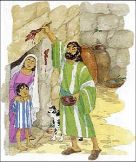 When God delivered the Israelites from Egypt, He commanded them to slay a lamb and mark their doorposts with its blood, so they would be spared from the angel of death who struck down the firstborn of the Egyptians (Exod 12). Later, the Israelites were required to offer blood sacrifices continually on the altar of the tabernacle and, later, the temple, to atone for their sins. On the Day of Atonement (Yom Kippur)—the holiest day of the Jewish year—the high priest entered the innermost part of the sanctuary, the Holy of Holies, with the blood of a goat. He sprinkled it on the mercy seat, the place of God's tangible presence, to make atonement for the sins of the people (Lev 16). Every day, while the Temple in Jerusalem stood, the blood of lambs was shed on the altar (Exod 29).
Why would God ordain such a messy, bloody ritual? The book of Leviticus gives us the answer:
For the life of a creature is in the blood, and I have given it to you to make atonement for yourselves on the altar; it is the blood that makes atonement for one's life. (Lev 17:11)
As we've seen, the wages of sin is death. Because we have sinned, we deserve to die. Our blood deserves to be shed. God's justice demands it. Yet His mercy longs to forgive us and offer us a new beginning each time we fall. If God were to wipe us out entirely, He would be just—but not merciful. If He were to forgive us without cost, He would be merciful—but not just. We instinctively understand this tension: we want evil to be punished, and we long for wrongs to be made right.
This is why God instituted animal sacrifice. The sin, guilt, and punishment due to the sinner were transferred to the animal. Its blood was shed in place of the sinner's; it died on his behalf. The blood of the sacrifice covered the sin and restored the worshiper to fellowship with God. We can imagine the enormous cost of sheep and cattle offered daily in the temple. This constant shedding of blood underscored the weight of sin and the price of forgiveness. Yet even that price was nothing compared to our true debt before God. Still, God accepted these sacrifices for a time, because they were only a shadow of a far greater sacrifice to come.
But in 70 C.E., the Romans destroyed the Jerusalem Temple, bringing a definitive end to the sacrificial system. Where now is the sacrifice that atones for the sins of Israel?
God's Solution: Jesus the Messiah
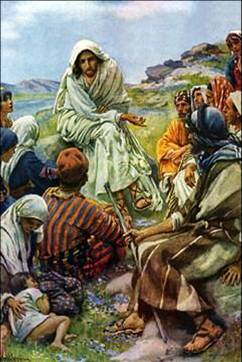
For God so loved the world that He gave His only begotten Son, that whoever believes in Him should not perish but have everlasting life. (John 3:16)
Fortunately, God provided a final, definitive, and universal solution to our sin problem. Two thousand years ago, He sent His Son—called Yeshua (Jesus)*, the Messiah of Israel*—to form a New Covenant with His people and to show us the way back to God. Jesus proclaimed repentance and the coming of the Kingdom of God. He healed the sick, forgave sins, and taught us how to live as children of God.
According to the Catechism of the Catholic Church (CCC 457–460), Jesus came for four principal reasons:
- To save us by reconciling us with God, through the offering of Himself as sacrifice for our sins;
- To reveal the Father’s love for us, through his words and deeds;
- To be our model of holinesss and show us how to live as God's children: "Love one another as I have loved you" (John 15:12);
- To make us partake of God’s life, as He had intended it from the very beginning.
Jesus the Savior
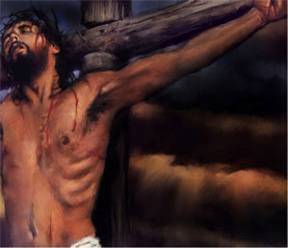
Jesus, the eternal Word and Son of God, took on our mortal nature and offered his life as an atoning sacrifice for our sins to reconcile us with the Father. His death on the cross was the Paschal sacrifice* that fulfilled all the offerings of the Old Covenant. He bore our punishment so that we might be set free and forgiven:
But He was wounded for our transgressions, He was bruised for our iniquities; The chastisement for our peace was upon Him, and by His stripes we are healed. All we like sheep have gone astray; we have turned, every one, to his own way; and the Lord has laid on Him the iniquity of us all. (Isa 53:5-6)
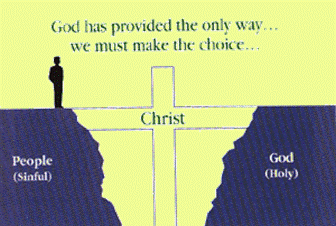
By dying, Jesus conquered sin and death. But His work did not end there. On the third day, He was physically raised from the dead by the power of the Holy Spirit. He then sent the Spirit to dwell within us—to reconcile us to God and to one another (1 Cor 15:3-8, Rom 5:5). By His resurrection, Jesus opened the way to heaven and eternal life. The gates to paradise, closed since the entrance of sin into the world, were opened again.
Jesus—true God and true man—is the bridge between God and humanity. He came to reconcile us with the Father and to give us a new life of faith, hope, and love as beloved children of God. If we accept Jesus and His message, we accept the fullness of God’s plan.
I am the way, the truth and the life. No one comes to the Father except through me. (John 14:6)
The Work of the Apostles
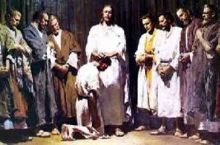
During His ministry in Galilee, Jesus called twelve apostles and prepared them to continue his mission. He gave a special role to Simon, renaming him Peter—"the rock." Jesus entrusted Peter with future leadership of the Church when He said to him:
You are Peter, and on this rock I will build My church, and the gates of Hades shall not prevail against it. And I will give you the keys of the kingdom of heaven, and whatever you bind on earth will be bound in heaven, and whatever you loose on earth will be loosed in heaven. (Matt 16:18-19)
On the day of Pentecost, fifty days after Jesus's Passover, the Holy Spirit descended upon the apostles. This marked the birth of the Church*. At first, the Church was composed entirely of Jews who believed that Jesus was the promised Messiah of Israel. Soon after, Gentiles were also welcomed into the community, and the Church became the place where Jews and Gentiles were reconciled in their common worship of the God of Israel.
The apostles, with Peter at their head, led the early Church and continued the work of Christ. As the Church grew, they ordained bishops and passed on the spiritual authority* that Jesus had given them:
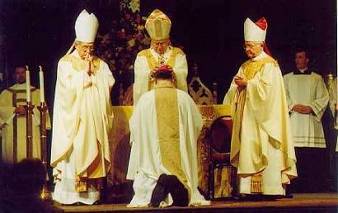
He who hears you hears Me, he who rejects you rejects Me. (Luke 10:16)
The things that you have heard from me among many witnesses, commit these to faithful men who will be able to teach others also. (2 Tim 2:2)
Today, the pope*—the successor of Peter—and the bishops, as the successors of the apostles, continue the mission of Jesus and the apostles: teaching His words, administering the sacraments that convey His life, and governing the Church.
The New Birth
Jesus taught that we must be born again—of water and the Spirit—to enter the kingdom of God:
Amen, amen, unless one is born again, he cannot see the kingdom of God... no one can enter the kingdom of God unless he is born of water and the Spirit. (John 3:3,5)
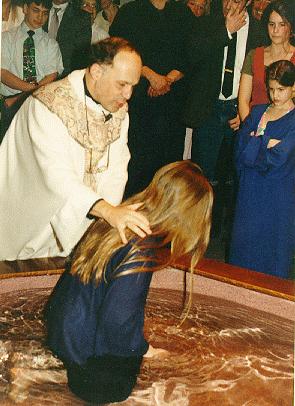 The new birth “of water and the Spirit” refers to faith in Christ and baptism*. Through baptism, we become members of the Church—the Body of the Messiah. For Jews, baptism does not mean abandoning Judaism. On the contrary, it fulfills the promise God made to Israel through the prophet Ezekiel:
I will sprinkle clean water on you, and you shall be clean... I will give you a new heart and put a new spirit within you; I will take the heart of stone out of your flesh and give you a heart of flesh. (Ezek 36:25-26)
Baptism is "the washing of regeneration and renewal by the Holy Spirit" (Tit 3:5). It cleanses us from sin, unites us with Christ's death and resurrection, restores our friendship with God, and opens the door to eternal life. Jesus Himself taught that faith in Him and baptism are essential for salvation. That's why He gave to his followers the Great Commission—to go into all the world and make disciples of all nations, so that everyone might have the chance to turn away from sin and be reborn to eternal life in Christ:
Go into all the world and preach the good news to all creation. Whoever believes and is baptized will be saved, but whoever does not believe will be condemned. (Mark 16:15-16)
The Catholic Church
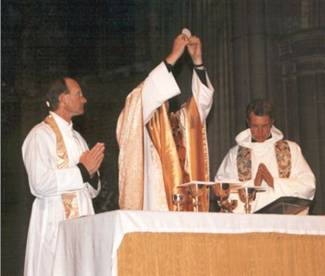
Jesus founded the Catholic (universal) Church*, guided by the Holy Spirit and led by the successor of Peter—the pope*—to continue His work on earth. The Catholic Church is God’s worldwide family. Through the Church, which the Bible calls the "pillar and foundation of truth," Jesus shares with us the way, the truth, and the life that make us a new creation and restore us to divine sonship.
I write so that you may know how you ought to conduct yourself in the house of God, which is the church of the living God, the pillar and foundation of the truth. (1 Tim 3:15)
We are united with Christ and receive God’s life especially through the liturgy* and sacraments* of the Church. These seven sacraments—beginning with baptism—are powerful encounters with the Holy Spirit, who transforms us so that we may grow in God's likeness, goodness, and love. The greatest of the sacraments is the Eucharist*: the sacrifice of the New Covenant and the family meal that nourishes us with Christ's own body and blood (John 6:51-58, Luke 22:19-20). The other sacraments are confirmation*, reconcilation (confession)*, the anointing of the sick*, matrimony*, and holy orders*.
Jesus also has given us his mother, Miriam (Mary)*, to be our own spiritual mother (John 19:27). Mary loves us, prays for us, watches over us from heaven, and helps us in the battle against evil (Rev 12). As God’s children, we are pilgrims on earth, journeying toward our true homeland in heaven, where we will share forever in God’s life and love with Him and with one another (Phil 3:20).
Our Response
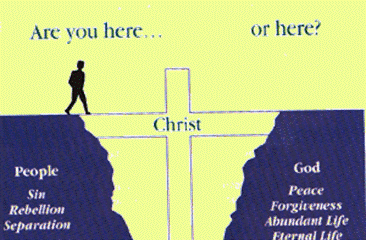
God calls us to repent—to turn away from sin and selfishness, to accept Jesus and believe in what He taught, to choose to follow Him, and to be baptized into new life. He calls us to join His Body, the Church (Acts 2:38), so that we can grow in the likeness of God until we are ready to share fully in His life in heaven.
This is our choice. Sin is a reality, and so is death. God is the source of all life. If we stubbornly reject Him in this life, He will respect our choice and allow us to remain separated from Him forever in the next. This is hell: the "state of definitive self-exclusion from communion with God and the blessed" (CCC 1033). Jesus warned soberly about the reality of hell (Matt 13:41-42, 25:41), and urged us to choose the narrow path that leads to life:
Enter by the narrow gate; for wide is the gate and broad is the way that leads to destruction, and there are many who go in by it. Because narrow is the gate and difficult is the way which leads to life, and there are few who find it. (Matt 7:13-14)
It is not God's desire that anyone be lost. He calls each of us to choose life and salvation. He created us to love Him and serve Him in this life, and to be with Him forever in the next—in a state of perfect fulfillment and joy. May we respond to His call and seek Him today.
For this is good and acceptable in the sight of God our Savior, who desires all men to be saved and to come to the knowledge of the truth. (1 Tim 2:3-4)
What to do Next
If you sense that God may be calling you into the Catholic Church:
- Begin building your relationship with God. Pray daily—speak with Him, and ask Him to lead you into His truth and light.
- Study the Catholic faith, either with Catholics for Israel, or through other faithful Catholic resources.
- Find a Catholic Church in your area. Start attending Mass and learning about Catholic prayer and liturgy.
- Connect with faithful Catholics who know and love their faith. They can support you on your journey to God.
- Speak with a priest about your desire to become Catholic. Listen carefully to his guidance—and make sure he is faithful to the Church. If he dissents from the Church's teachings as presented in the Catechism, or tells you that you don't really need to become Catholic, walk away and find another priest.
The Gospel of Jesus the Messiah in a Nutshell
- God loves you and has a wonderful plan for your life.
- Sin separates us from God. We are not capable of repairing this break on our own.
- Jesus has come to reconcile us with God and give us eternal life.
- Jesus has given us the Church, though which he shares with us the way, the truth, and the life.
- God calls us to repent and be baptized for the forgiveness of sins, to follow Jesus, and to join ourselves to his Body—the Church.
See also:
The Gospel Message* (PowerPoint)
The Story of Salvation
Why be Catholic?