

Source: CAMERA (June 9, 2026). Reprinted by permission.
Introduction
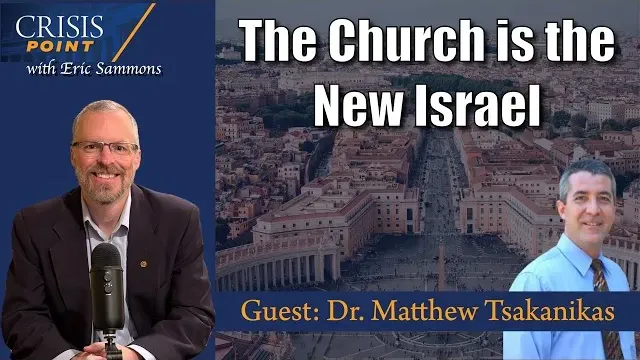
A recent interview Crisis Magazine editor-in-chief and Crisis Point Podcast host Eric Sammons conducted with Christendom College Professor Matthew A. Tsakanikas features a number of problems, including:
- Constructing a false dichotomy between inheriting the land of Israel and the world.
- Inaccurately suggesting:
- The antitype negates the type of the land of Israel.
- The ceremonial law was temporary and is now obsolete.
- Jesus’ identification with the Temple negates its continuing theological significance.
- Building a Third Temple is a central motivator of Christian Zionist support for the State of Israel.
- Questionably claiming Paul identifies the Church as the “Israel of God.”
- Incorrectly claiming Religious Zionism is a majority position.
- Misrepresenting the International Holocaust Remembrance Alliance Working Definition of Antisemitism.
- Omitting Catholic affirmations of beliefs associated with theological Zionism.
Constructing a False Dichotomy Between Inheriting the Land of Israel and the World
Tsakanikas seems to construct a false dichotomy in assuming an incompatibility between the idea that Abraham’s descendants will inherit the world and the Jewish people will inherit the land of Israel:
[Theological Zionists] claim […] that the [biblical] promises have not been superseded. Even St. Paul in Romans 4 says the promise to Abraham was that his descendants shall inherit the world, not specifically the boundaries given to him in Genesis 12 or in Genesis 17.
However, the biblical promises’ expansion need not imply that the people of Israel no longer inherit the land of Israel. As The King’s University Director of Messianic Jewish Studies and Professor of New Testament and Jewish Studies David Rudolph has observed:
In the Torah and in Second Temple Judaism, Abraham’s call to be “heir of the world” and the particularity of the land promise were not seen as either-or trajectories but both/and. If Paul had territory in view in Romans 4:13, he had one eye on the universal aspect of the promise and the other on the particular. Michael Vanlaningham concludes, “Rather than removing the privilege of the land from Israel, Paul appears to affirm it” (The New Christian Zionism: Fresh Perspectives on Israel & the Land, p. 177).
In fact, there are multiple indications that Paul as depicted in the New Testament upheld the continuing validity of the biblical promise of land to the Jewish people. For example, Paul in the Book of Acts identifies as an “inheritance” the land God gave to the people of Israel while preaching to a synagogue audience in Antioch Pisidia: “[A]fter destroying seven nations in the land of Canaan, God gave this people Israel their land as an inheritance” (Acts 13:16b-17, 19).
Similarly, the Letter to the Romans that Tsakanikas references features numerous affirmations of the continuing positive theological significance of the land of Israel for the Jewish people. For example, Romans 9:4 asserts that the “glory” (doxa), “covenants” (diathēkai), “giving of the law” (nomothesia), and “worship” (latreia) belong to Paul’s kinsmen “according to the flesh” (fellow Jews). In explaining the connection of “glory” and “worship” to the territory of the land of Israel, Boston University Aurelio Professor of Scripture Emerita, Hebrew University of Jerusalem Comparative Religion Professor, and New Testament scholar Paula Fredriksen observes:
Behind Paul’s Greek word for “glory” stands the Hebrew kavod, which refers specifically to God’s glorious presence, thus to the location of that presence, namely his temple in Jerusalem. And latreia (“worship” or “offerings”) points to the Hebrew avodah: Paul here names the sacrificial cult, revealed in scripture and enacted around Jerusalem’s altar, as a defining privilege of Israel (Paul: The Pagans’ Apostle, p. 35).
Paul in Romans 9:25-26 quotes a passage from the biblical book Hosea, but adds language underscoring the importance of geography not found in any known version of the Septuagint: “And in the very place where it was said to them, ‘You are my people,’ there they shall be called children of the living God” (Hos. 1:10) (additional terminology in italics). In explaining the significance of this terminological addition to the biblical text, Rudolph observes:
Since the Greek word ἐκεῖ (translated “there” in Rom[.] 9:26) does not appear in any known Septuagint version of Hosea, it would seem to suggest that Paul is placing an emphasis on this geographic location. What do the words “in the very place” and “there” point to? In the context of Hosea 1, these terms refer to the land of Israel. Moreover, the Hosea 1:10 text that Paul quotes is in the middle of the prophet’s description of how the land and seed promises to the patriarchs are fulfilled in the eschaton. In Hosea, a messianic king is appointed and then possession of the land is restored” (The New Christian Zionism, p. 192).
The Hartford International University for Religion & Peace Rabbi Stanley M. Kessler Distinguished Professor of New Testament and Jewish Studies Amy-Jill Levine argues that Paul may very well have had the land of Israel in view in describing the salvation of Israel in Romans 11:
Paul’s reference to “all Israel” (Romans 11:26a) may well mean exactly that—the Jewish nation, Abraham’s descendants according to the flesh. In Paul’s view, their salvation will occur together with the salvation of the non-Jews, as in Romans 15:10: “and again he says, ‘Rejoice, O gentiles/pagans with his people’” […] Jews are not subsumed into a broader assembly, and they do not lose their ethnic identity. Since they do not lose their ethnic identity, they do not lose their connection to the land. Rather, that connection, like circumcision and kashrut and Shabbat-observance, is presupposed. The focus on the land is then reinforced in Romans 11:26b, when Paul presumes the ongoing role of Zion, whence the Deliverer will come (Peace and Faith: Christian Churches and the Israeli-Palestinian Conflict, p. 144).
Fredriksen contends that this Romans passage articulates Paul’s expectation that the twelve tribes of Israel would be restored in the land of Israel in the eschatological future:
When Paul speaks of End-time redemption, he too recalls this ancient lineage going back to Noah: the gentiles’ plērōma means “all seventy nations.” So too Paul’s evocation of the plērōma of Israel, pas Israēl: his phrasing recalls the patriarchal narratives, the lineage of Abraham passing through Isaac to Jacob and thence to Jacob’s twelve sons, the “fathers” of Israel’s tribes. “All Israel” conjures the full restoration of these twelve tribes, another traditionally eschatological event. As in Deuteronomy 32.43, which Paul will quote at the end of this letter, so also here in Romans 11: the ingathering of Israel is linked immediately to the inclusion of the nations” (Paul, p. 161).
Paul’s allusions in Romans 11:26-27 to Isaiah 27:9 and 59:20 also suggest that Paul thought Israel’s salvation would include a territorial dimension. This belief is suggested in an analysis of this Romans passage with its intertextual allusions to Isaiah by St. Bonaventure University Professor Emeritus of Theology and Franciscan Studies Christopher Stanley adduced by the University of Kansas New Testament scholar Mark D. Nanos:
Though the story is not identical, the obvious parallels between this passage [Isa. 27:9] and Isa. 59.20-63.7 make it easy to see why an ancient reader (who worked from the premise of a unified Scripture) might have felt compelled to interpret the one passage in the light of the other […] Both passages reach their climax in the return of the dispersed children of Israel to their land, in the one case by the supernatural activity of Y[-]H[-]W[-]H himself, in the other by the hand of the defeated nations. The final scene shows the fulfillment of all the dreams and aspirations cherished by Y[-]H[-]W[-]H’s people over the years: eternal peace and security in their own land (The Mystery of Romans: The Jewish Context of Paul’s Letter, p. 280).
Another indication that Paul maintained that the people of Israel would be restored to the land of Israel in the eschatological future is his reference in Romans 11:27 to Jeremiah 31. As Moody Theological Seminary Professor of New Testament J. Brian Tucker explains:
Within a future eschatological miracle understanding of “all Israel will be saved” is an often overlooked idea that this also means that Israel will need to be restored to the land […] In Rom[.] 11:27, Paul writes, “And this is my covenant with them, when I take away their sins.” This citation from Jeremiah 31 highlights the prophetic hope for the restoration of the houses of Judah and Israel (Jer[.] 31:31, 33-34). The context of Jeremiah predicts a return from exile to the land for God’s people […] It is more likely that Paul has been moving towards the conclusion that begins at 9:13: “his concern for Israel includes her exile … his hope for Israel’s salvation includes the restoration of Israel and Judah.” The reference to Jer[.] 31:33 in Rom[.] 11:27 suggests that since restoration in the land was part of the prediction in Jeremiah, part of the “mystery” that Paul is revealing includes Israel’s restoration. This is particularly probable given the subjugation of Israel at the hands of the Romans in Paul’s day (Reading Romans After Supersessionism: The Continuation of Jewish Covenantal Identity, pp. 192-194).
Thus, many New Testament passages not only suggest that an expansion of the biblical promise of land would not have been viewed as incompatible with the continued positive theological significance of the land of Israel for the Jewish people, but also affirm that the land of Israel continues to hold positive theological significance for the Jewish people.
Inaccurately Suggesting the Antitype Negates the Type of the Land of Israel
Sammons suggests that the physical land of Israel was a type that is no longer in effect:
[F]or Christians, the ancient land of Israel was a type, so even if it was the same land, it doesn’t mean it matters to us as Catholics […] I’m not saying people shouldn’t go on pilgrimages to the Holy Land. There are a lot of reasons to do that, but not as some idea that somehow […] the type is still in effect, so to speak.
However, the Kenrick-Glennon Seminary Associate Professor of Theology Lawrence Feingold has indicated that Catholics can understand the type of the physical land of Israel as retaining its literal significance while pointing to an antitype holding additional meaning:
The reality that the type points to (the antitype) does not replace the type, although it often fulfills its meaning in a higher way. In other words, the existence of a spiritual sense of Scripture does not replace, annul, or stand in competition with the literal sense, on which it depends for its meaning (Contemporary Catholic Approaches to the People, Land, and State of Israel, p. 7).
Similarly, the Catholic theologian and Sacred Heart Major Seminary Associate Professor of Old Testament & Biblical Languages André Villeneuve has observed that even if one accepts that the land points beyond itself, this need not negate other levels of significance, including the plain-sense meaning of the biblical promise of a specific land to the people of Israel:
An authentic Catholic reading of the Bible attends to the four senses of Scripture: literal, christological, ecclesial, and eschatological (CCC 115–118). To dismiss or collapse the literal and eschatological senses into a purely spiritual reading is not Catholic exegesis. The promises of Israel’s physical ingathering to their ancestral land have not been fulfilled in Christ or the Church, and their open horizon leaves ample room for Catholic Zionism.
Therefore, belief that the land of Israel is a type need not negate the literal significance of the land of Israel. In fact, prominent Catholics theologians, like the Venerable Bede in his Commentary on Luke 21:24 and Saint Thomas Aquinas in his Commentary on Jeremiah 31:37, have suggested that it is legitimate for Catholics to believe that a return of Jewish people to their ancestral homeland is a distinct eschatological possibility. Given such Catholic views, Gideon Lazar, a Catholic who was raised Jewish and has been a guest on Sammons’ Crisis Point Podcast, has cautioned Catholics against “dismiss[ing] a literal land promise as the naïve theory of modern dispensationalists stemming from the Scofield Reference Bible.”
Inaccurately Suggesting the Ceremonial Law was Temporary and is Now Obsolete
In the interview, Tsakanikas suggests that the ceremonial law is temporary. For example, he states:
[W]e cherish and respect the purposes that the ceremonial law served, but of the parts of the Old Law, the civil, the ceremonial, and the moral, you definitely no longer keep the ceremonial law. That’s super clear in St. Paul’s “You’re justified by faith apart from works of law.” It was specifically referring to what’s now obsolete because they never communicated the Holy Spirit because they were a foreshadowing, not the reality.
However, absent from Tsakanikas’ description here is the fact that Paul himself appears to have continued observing Jewish practices, including ceremonial ones. As the Bishop M. Kevin Britt Chair of Dogmatic Theology and Christology at Sacred Heart Major Seminary Robert Fastiggi has observed:
It seems, though, that many Christians of Jewish background continued to observe Old Covenant laws of ritual purity and worship […] Paul himself still seemed to follow Jewish traditions. At Cenchrea, “he had his hair cut because he had taken a vow” ([Acts] 18:18). This was presumably the Nazirite vow described in Numbers 6:1-21 and taken by the judge, Samson (Judg[.] 16:17). When the Jewish high priest, Ananias, brings charges against him to the governor, Paul declares: “I worship the God of our ancestors and I believe everything that is in accordance with the law and written in the prophets” (Acts 24:14). He states that he has come to Jerusalem “to bring alms for my nation and offerings” (24:17). When he is brought before the Roman procurator, Festus, in Caesarea, Paul defends himself by saying: “I have committed no crime either against the Jewish law or against Caesar” (25:8). Commenting on Acts 24:11-13, William S. Kurz, S.J., notes that “Paul does not consider his conversion to Christ a departure from Judaism, rather, he has continued his Jewish devotional practices” (From Sinai to Rome: Jewish Identity in the Catholic Church, p. 111).
Pontifical University of St. Thomas Aquinas Lecturer Gavin D’Costa argues that Catholic documents suggest that Jewish practices could remain in force. Thus, although the Catholic document Cantate Domino has the “authority[…] of a solemnly binding doctrinal teaching document” for Catholics” and appears to formally prohibit “the practice of the ceremonial Mosaic law, both within and outside the Catholic Church” (Catholic Doctrines on the Jewish People after Vatican II, p. 33), D’Costa argues that there are grounds for holding that this prohibition was contingent on circumstances that no longer apply. For example, D’Costa observes that the document suggests that “[t]he ritual ceremonies of Judaism were instituted by God and were efficacious” (Ibid., p. 43), but were prohibited when such practice was deemed to be an expression of freely rejecting Jesus. However, D’Costa suggests that “if they [Jews] had not freely rejected Christ, but were acting in invincible ignorance, then the continuations of those ritual practices may still be considered divinely instituted and efficacious” (Ibid.).
Similarly, the idea that Jewish practices lost their value “due to the disappearance of the People of the First Covenant within the Church” (Ibid.) would seem to suggest that such Jewish practices could be permitted when a Jewish presence within the Church is restored as D’Costa believes is happening with the emergence of Hebrew Catholics:
Does the converse hold: when there are “carnal Jews” within the Church, then it may be appropriate that the “rites and ceremonies of the old Law” are permitted again to those who descend in flesh from Israel? This is important because Hebrew Catholics today testify to the reality that “carnal Jews” of the flesh have reappeared within the body of Christ (Ibid., p. 45).
D’Costa concludes: “[T]here is good reason for competent authorities to restore both Acts 15:29 and its concomitant: that Jewish practices within the ecclesia are perfectly legitimate as they were in the early liturgical life of the church” (Ibid., p. 52). He even considers the possibility that the presence of some Mosaic ceremonial practices in the East and West of the Church historically could have been “foreshadowing the return of the time when the Jewish witness would one day return to the Church” (Ibid., p. 53).
Fastiggi concludes that while Jewish practices are not a means to achieve salvation, they may still be practiced by Jewish followers of Jesus as integral components of a Jewish “religious and cultural patrimony” that developed as part of a divine covenant:
The Jewish culture is the culture of Jesus, the Virgin Mary, and the apostles. It is a culture that was formed by a covenant with God, a culture that is good and holy. There is no reason the practices that nourish the Jewish way of life should not be preserved by Jews who have embraced Christ and his Church. These Jewish traditions can be celebrated as part of their religious and cultural patrimony, but not as means of salvation (From Sinai to Rome, p. 125).
Similarly, Feingold maintains that the observance of Jewish practices, including ceremonial ones to which many Catholics have been correctly attracted, is valid as long as the primacy of Christ and the Church is acknowledged and the Church’s judgment is accepted:
Although in the encyclical [Ex quo primum] [,] Benedict XIV was not considering the situation or practice of Hebrew Catholics, the principle he lays down is significant with regard to the practice of celebrating the Passover Seder and other elements of Jewish prayer, to which many Catholics are rightly attracted. They are legitimate as long as one recognizes the primacy of Christ and the Church, and defers to her judgment (Ibid., p. 124).
Thus, Tsakanikas’ assertion that Catholics believe that “you definitely no longer keep the ceremonial law” and his suggestion that this view is based on Paul not only omit Paul’s apparent continued observance of Jewish practices, but also exclude legitimate alternative Catholic theological perspectives that insist on the permissibility and value of the observance of Jewish ceremonial practices within the Catholic Church.
Inaccurately Suggesting Jesus’ Identification with the Temple Negates the Building’s Theological Significance
Sammons suggests that the identification of Jesus with the Temple should incline one to believe that the Temple building does not continue to have any theological significance: “What we’re saying as Catholics is all those promises did actually happen, but the priesthood was fulfilled in, of course, Christ’s high priesthood […] The Temple is Christ’s body—he makes that so clear, too […] and then, the land.”
However, the Anglican theologian and Reformed Episcopal Seminary and Jerusalem Seminary Distinguished Professor of Anglican Studies Gerald R. McDermott has argued that statements and actions of Jesus and his disciples suggest that identification of Jesus with the Temple is not incompatible with belief in the continuing value of a Jerusalem Temple:
[W]hen Jesus quoted Isaiah’s prediction that the temple would become “a house of prayer for all nations” (Mark 11.17; Is. 56.1), he seemed to concur, as [former Duke Divinity School Dean and New Testament scholar] Richard Hays suggests in his recent Reading Backwards, with Isaiah’s vision of “an eschatologically restored Jerusalem” where foreigners would come to God’s holy mountain to join the “outcasts of Israel” whom God has “gathered” (Is[.] 56.7-8). Hays adds that John’s figural reading of Jesus’ body as the new temple (John 2.21) “should be read neither as flatly supersessionist nor as hostile to continuity with Israel.” It does not deny the literal sense of Israel’s Scriptures—that the temple was God’s house—“but completes it by linking it typologically with the narrative of Jesus and disclosing a deeper prefigurative truth within the literal historical sense.” That the apostles saw the temple as both God’s continuing house and also a figure for Jesus’ body is shown by their participation in temple liturgies even after the Temple’s leaders had helped put their messiah to death (Acts 2.46).
To assume, therefore, that the Temple building loses its theological significance simply because Jesus identifies himself with it is misleading. In addition, Sammons’ statement inaccurately suggests a conflation of the divine promise of land with the Temple. In fact, as Villeneuve has observed, the divine promise of land to Abram’s descendants “stood independently of any Temple,” with biblical texts frequently mentioning the former without reference to the latter (e.g., Genesis 15 and Ezekiel 36:24-28).
Inaccurately Suggesting that Building a Third Temple is a Central Motivator of Christian Zionist Support for the State of Israel
Sammons suggests that a desire for a Third Temple motivates Christian Zionist support for the State of Israel: “I know a lot of Christian Zionists now want a Third Temple [to] be created.” However, the centrality of building a Third Temple as a motivator of Christian Zionist support for the State of Israel is not reflected in survey data analyzed by scholars of Christian Zionism Motti Inbari and Kirill Bumin, who found “no support for the hypothesis that premillennial dispensation[alist] theology, which expects the Jews would build a Temple for God prior to the events of the Second Coming, is a statistically significant predictor of support for Israel” (Christian Zionism in the Twenty-First Century: American Evangelical Public Opinion on Israel, p. 40). In commenting on the significance of this finding, Inbari and Bumin note: “This finding is important since many commentators do associate evangelical support for Israel with the reconstruction of the Temple in the near future. Our results fail to find support for this evangelical motivation” (Ibid.). In fact, Inbari and Bumin observed:
[E]schatological statements which require that the support for Israel is followed up by deliberate action by the believers (e.g., rebuilding the Third Temple, or expecting Jews to convert to Christianity with Jesus’ Second Coming) came last on a long list of motivations for supporting Israel (Ibid., p. 175).
In explaining the significance of this finding, Inbari and Bumin note: “This means that warmer eschatological expectations [that require that the support for Israel is followed up by deliberate action by the believers] […] do not play a significant role in the motivations of the contemporary evangelical audience” (Ibid.).
Questionably Claiming Paul Identifies the Church as the “Israel of God”
Tsakanikas questionably suggests that Paul identifies the Church as the “Israel of God” when he states: “St. Augustine is very clear following St. Paul—it’s St. Paul in Philippians 3:3 [who says]: ‘We are the true circumcision’ because he’s clearly referenc[ing] that we now are the ‘Israel of God,’ as he does in Galatian 6:16.” However, Villeneuve has observed that identifying the Church as the “Israel of God” on the basis of the one biblical mention of “Israel of God” is a rather tenuous reed on which to rest one’s expansive case for a supersessionist theology:
Galatians 6:16 is the only place in the New Testament where the phrase “Israel of God” appears—and building a sweeping replacement theology on one ambiguous phrase is a classic example of cherry-picking. In contrast, the terms “Israel” and “Israelite” appear nearly 2,800 times in Scripture (including 77 times in the New Testament)—and always refer to the ethnic descendants of Jacob, the Jewish people, or their land. The overwhelming biblical witness presents Israel as a distinct people, loved by God, called by God, and tied to a specific land through covenant.
Villeneuve further points out that Tsakanikas “appeals to an alternate translation of the Greek conjunction kai (καί), insisting it should be rendered not as the usual ‘and,’ but as ‘namely’ or ‘even’—suggesting that Paul equates all who follow Christ with the ‘Israel of God.’” However, as Villeneuve explains, this interpretation of Galatians 6:16 is contextually unwarranted:
[T]he Greek text of Galatians 6:16 reads, “εἰρήνη ἐπ’ αὐτούς καὶ ἔλεος, καὶ ἐπὶ τὸν Ἰσραὴλ τοῦ θεοῦ” — “Peace and mercy be upon them, and upon the Israel of God.” The key word kai (καί) is almost always translated “and” in the New Testament—over 95% of the time. While it can occasionally mean “even” or “namely,” that is grammatically rare and contextually unwarranted here.
Villeneuve observes that the Catholic The New American Bible Revised Edition correctly translates the passage as follows: “Peace and mercy be to all who follow this rule and to the Israel of God.” According to Villeneuve, this translation “makes the most sense contextually,” as “Paul is offering a blessing to two distinct but related groups” in this passage:
- All who follow this rule—that is, Gentile and Jewish Christians who live by the gospel of grace;
- The Israel of God—likely referring specifically to believing Jews who are faithful to the gospel and remain part of the ethnic people of Israel.
To reiterate, Villeneuve argues that the “Israel of God” is not identical with the Church, but likely refers to “the Jewish segment of the Church” and “may well be Paul’s way of ensuring that believing Jews are not forgotten in the new creation he proclaims.” Therefore, Villeneuve concludes: “To reinterpret kai as ‘namely’ flattens Paul’s subtle pastoral tone and forces the text into a supersessionist frame it doesn’t require. It is a move that reveals more about the interpreter’s theology than about Paul’s intent.”
Incorrectly Claiming Religious Zionism is a Majority Position
Tsakanikas incorrectly claims that Religious Zionism is “a majority position” today, although it is unclear if he is referring to a majority of American Jews or a majority of Israeli Jews:
[T]he vast majority of rabbis were anti-Zionist in the late 1800s. They saw it as a heresy, and it’s not until the British with their Christian Zionism started pushing them in the land they began to adopt and change their minds and then, of course, World War II and the Holocaust led to, ultimately, a change in mind from being a minority position of religious Zionism to now today a majority position.
Similarly, Tsakanikas states:
[W]hat Zionism used to be prior to 1945 has really shifted since 1967, and what was a secular desire for a homeland based on international law has now turned into a Zionism post-1967 under the extremist cabinet post-2020 of Netanyahu of theological Zionism where you then have a biblical mandate to take illegally—without an existing mandate from God anymore since the New Covenant—to take land from the Palestinians, Christian and Muslim, which is illegal, of which they have no divine right, according to Catholic theology.
If Tsakanikas is claiming that a majority of Jewish people in the United States identifies as Religious Zionist, he is mistaken. According to a 2025 Jewish Federations of North America survey, although 70% of Jewish American adults reported “feel[ing] emotionally attached to Israel,” and 60% indicated the State of Israel “made them proud to be Jewish,” only 37% of Jewish Americans identified as “Zionist,” let alone Religious Zionist. If Tsakanikas is claiming that a majority of Israeli Jews identifies as Religious Zionist, he is also mistaken. Another 2025 survey showed that 28% of Israeli Jews “identify as religious-Zionist.”
Misrepresenting the International Holocaust Remembrance Alliance Working Definition of Antisemitism
In the interview, Tsakanikas suggests that a position that regards anti-Zionism as tantamount to antisemitism is based on the International Holocaust Remembrance Alliance (IHRA) Working Definition of Antisemitism: “The lobbying in America has this idea now that if you are anti-Zionist, now, you’re an antisemite based on the new International Holocaust Remembrance Association [sic] definition.” In fact, the Chair of the Alliance for Academic Freedom and University of Illinois at Urbana-Champaign Jubilee Professor of Liberal Arts & Sciences Cary Nelson has noted: “The IHRA Definition’s examples are powerful warning signs that we may be dealing with antisemitism in a given case, but, as David Hirsh (2021c) argues, they are not an automatic, machine-like classification” (Hate Speech and Academic Freedom: The Antisemitic Assault on Basic Principles, p. 211-212). While Tsakanikas expresses concern about “lobbying,” Nelson has observed that the definition’s “examples [were not] intended to be a blueprint for speech codes or legal action” (Ibid. p. 212). If Tsakanikas means to suggest that a position holding that criticism of the State of Israel is tantamount to antisemitism is based on the IHRA Working Definition of Antisemitism, he is mistaken, as the definition allows for legitimate criticism of the State of Israel: “[C]riticism of Israel similar to that leveled against any other country cannot be regarded as antisemitism.”
Omitting Catholic Affirmations of Beliefs Associated with Theological Zionism
Tsakanikas claims that “Catholics […] [a]re against theological Zionist interpretations.” However, in the interview, he omits prominent Catholic leaders who have affirmed beliefs that have come to be associated with theological Zionism. For example, the preacher of the papal household of Pope John Paul II, Raniero Cantalamessa, cites specific Old Testament texts while invoking a relevant New Testament statement by Paul in noting: “We share with the Jews the biblical certainty that God gave them the country of Canaan forever (Genesis 17:8, Isaiah 43:5, Jeremiah 32:22, Ezekiel 36:24, Amos 9:14). We know that the gifts and the call of God are irrevocable” (The Mystery of Christmas: A Comment on the Magnificat, Gloria, Nunc Dimittis, p. 38). By connecting the land God gave to the Jewish people to “the gifts and the call of God are irrevocable” (Romans 11:29) mentioned by Paul—a biblical verse Tsakanikas discusses in the interview—Cantalamessa suggests this specific land remains one of the irrevocable gifts God gave the Jewish people.
The Catholic document Notes on the Correct Way to Present Jews and Judaism in Preaching and Catechesis in the Roman Catholic Church acknowledges the biblical basis of a Jewish connection to the land of Israel. This acknowledgment is significant, as the Old Testament teachings on which this connection is based have authority for Catholics. As D’Costa explains:
If paragraph one deals with Jewish self-understanding that is respected and acknowledged, the next paragraph establishes […] the Jewish attachment to the land “finds its roots in Biblical tradition.” Jewish self-understanding is biblically justified. This refers to the Old Testament teachings that have authority as revelation for Catholics (Catholic Doctrines on the Jewish People after Vatican II, p. 130).
Father Antoine Lévy points out that the document’s acknowledgement of the biblical justification of a Jewish attachment to the land of Israel reflects the fact that “this religious argumentation is [not] foreign to Catholic theology” and can even be regarded as “valid” even if the document holds that this view “cannot be the one and exclusive criterion of justice regarding the conflict” (Contemporary Catholic Approaches to the People, Land, and State of Israel, p. 201). He argues that a theological view of the State of Israel can involve revelation beyond morality and politics: “I claim that the revelation is not confined to providing moral and political laws with their ultimate source of intelligibility. Revelation is also about the destiny of a concrete and very unique nation from the time of Abraham to that of Jesus” (Ibid., p. 203). While Tsakanikas states: “We [Catholics] certainly can accept […] the claims that made the secular State of Israel,” Father Lévy argues that the international agreements and decisions that reference these claims necessarily require a religious interpretation to be comprehensible:
[T]he 1948 international agreement, just as other similar decisions, is incomprehensible without the specific religious interpretation of the Bible associated with Zionism. Religion lurks behind about every aspect of the conflict. How could considerations regarding justice not take the religious perspective into account (Ibid., p. 207)?
In her ethnographic study of nuns and monks in Israel, The Merrimack College Assistant Professor of Religious and Theological Studies Emma O’Donnell Polyakov notes that when he was still the Apostolic Administrator of the Latin Patriarchate of Jerusalem, Archbishop Pierbattista Pizzaballa suggested that Catholics might have lost sight of the theological significance of the physical land of Israel and the Jewish presence there:
[T]he notion that the Jewish presence in the land of Israel might be significant for Christians as well can also be found among more public and authoritative voices within the Church hierarchy […] Addressing what he sees as an overspiritualization or abstraction of the land within most Christian notions of the Holy Land, he [Archbishop Pizzaballa] commented, “Our understanding of the land now as holy is purely spiritual. For the Jews, it is spiritual[,] of course, but not only. In Judaism, there is a very strong connection between faith, people, and land; it’s really concrete. And we Christians spiritualize it.” He laughed and added regretfully, “Maybe, too spiritualized!” He continued, “This is also my question, I am wondering. God is saying something. I don’t think that the people of Israel who live in Israel are just a causality, are just an accident.” Pizzaballa refrains from making any definitive statements about the spiritual meaning of the land to Christians or about the Jewish presence in Israel, but he suggests that both might be theologically significant to Christianity (The Nun in the Synagogue: Judeocentric Catholicism in Israel, pp. 94-95).
While Archbishop Pizzaballa does not make a definitive statement on the spiritual significance of the land of Israel for Christians or the presence of Jews there, he does, as Polyakov indicates, suggest that the subject of the land and the phenomenon of Jewish people living there could be theologically significant for Christians.
Popes have also made statements suggesting they see theological significance in the return of Jewish people to the land of Israel. For example, in a 1991 address to a Jewish audience in Brasilia, Pope John Paul II applied to contemporary Jewish people a prophetic passage from Ezekiel regarding the ingathering of the Jewish people to the land of Israel:
May our Jewish brother[s] and sisters, who have been led “out from among the peoples and gathered from the foreign lands” and brought back “to their own country” [Ezek. 34.13], to the land of their ancestors, be able to live there in peace and security on the “mountains of Israel,” guarded by the protection of God, their true shepherd (The Saint for Shalom: How Pope John Paul II Transformed Catholic-Jewish Relations, p. 225).
The choice of Pope John Paul II to use this prophetic biblical text in referencing Jews who have returned to the land of Israel following the establishment of the State of Israel is theologically suggestive.
Pope Emeritus Benedict XVI expressed his belief that the establishment of the State of Israel demonstrates God’s fidelity to the Jewish people: “The Vatican…has recognized the State of Israel as a modern constitutional state, and sees it as a legitimate home of the Jewish people […] [I]t expresses God’s faithfulness to the people of Israel” (“Grace and Vocation,” p. 178). In the same vein, Pope Emeritus Benedict XVI has also remarked: “It is not difficult, I believe, to see that in the creation of the State of Israel, the fidelity of God to Israel is revealed in a mysterious way.”
Similarly, Duquesne University Professor of Catholic Studies and Theology William M. Wright IV holds that the return of Jewish people to the land of Israel is “an instance of God’s loving-kindness and faithfulness to his covenant people,” which “Catholics can acknowledge […] in a manner akin to honoring the abiding value and religious significance of the plain-sense dimensions of the Old Testament and the realities which it presents” (Catholic-Jewish Engagements on Israel: Holy Land, Political Territory, or Theological Promise?, p. 100).
The Catholic theologian and philosopher Jacques Maritain held that the return of Jewish people to the land of Israel and the establishment of the State of Israel demonstrate God’s faithfulness to the Jewish people:
[T]he return of part of the Jewish people to the Holy Land, and its reestablishment there (of which the existence of the state is a sign and guarantee), is the refulfillment of the divine promise which is not withdrawn. One remembers that which was said to Abraham, Jacob, and Moses, and that which Ezekiel proclaimed….[I]t is not impossible [that the establishment of the state of Israel is a kind of prelude to the realization of the prophecy]. But surely[,] we should keep in mind our respect for the ways of God? And I have no doubt that this event, mysterious as it is for Jews and Christians alike, bears the sign of God’s faithful love for the people which is ever His (Zeal for Zion: Christians, Jews, & the Idea of the Promised Land, p. 198).
The Catholic theologian and scholar Monsignor John M. Oesterreicher affirmed the success of the State of Israel as an expression of God’s favor. As the University of California, Berkeley Professor of History John Connelly observes:
In his last decades, Oesterreicher acted as a Christian Zionist, insisting that the success of Israel was a sign of divine favor, due not simply “to the cunning of her statesmen, the superior strategy of her generals, the bravery of her soldiers, and the steadfastness of her citizens,” but to the “‘outstretched arm’ (Exodus 6:6) of the Lord which once more rescued His people…Today’s Israel is new proof that God stands by His covenant; that the last word lies, not with the inventor of the “final solution[,]” but with Him (From Enemy to Brother: The Revolution in Catholic Teaching on the Jews, 1933-1965, p. 279).
The former Archbishop of Vienna and key editor of the Catechism of the Catholic Church Cardinal Christoph Schönborn has suggested a connection between biblical prophecy and the establishment of the State of Israel in asserting: “Hardly anybody will dispute that the foundation of this state [of Israel] had something to do with the biblical prophecy even if that something is hard to define.”
Conclusion
As the above analysis has shown, the Crisis Point Podcast interview featuring Sammons and Tsakanikas includes numerous problems. One problem is the construction of a false binary between inheriting the land of Israel and the world. Another problem is the interview’s inaccurate suggestions that the antitype negates the type of the land of Israel, the ceremonial law was temporary and is now obsolete, Jesus’ identification with the Temple negates the building’s continuing theological significance, and building a Third Temple is a central motivator of Christian Zionist support for the State of Israel. The interview also promotes the questionable claim that Paul identifies the Church as the “Israel of God.” In addition, the interview incorrectly claims Religious Zionism is a majority position, misrepresents the International Holocaust Remembrance Alliance Working Definition of Antisemitism, and omits Catholic affirmations of beliefs associated with theological Zionism. Hopefully, future Crisis Point Podcast interviews and Crisis Magazine articles will avoid these problems.