

 Part I: Israel and the Church from Abraham to Today - The origins of Israel: the Patriarchs; the Exodus and Mount Sinai; the kingdom of Israel; exile and return. Hebrews, Israelites and Jews. The Messiah and his rejection by his own people. The birth of the Church. Early Jewish-Christianity, the growth of Gentile Christianity, and the parting of ways. Israel in the patristic writings: the rise of "replacement theology." Christian anti-Semitism in the Middle-Ages. Theological evaluation: Israel and the Church in the New Testament.
 There are no disagreements between Judaism and Catholicism. Where their teachings diverge, it is because they apply to two different, well, let’s call them universes, two ways that human experience is unified (uni-verse, “turned into one”) in relation to G-d according to their respective covenants.
Memory and Reconciliationinvites the Church to examine the sins of her members in history, including those committed against the Jewish people. Section 5.4 highlights the unique gravity of Christian anti‑Judaism, calling Catholics to repentance, renewed fidelity to Israel’s enduring covenant, and a deeper commitment to healing the relationship wounded across centuries. It frames this examination not as self‑accusation but as a purification of memory that strengthens the Church’s witness to the God of mercy and truth.
The 1985 Notes deepen the Church’s postconciliar teaching by clarifying how Judaism should be presented in Catholic preaching, catechesis, and scholarship. They stress respect for Jewish self-understanding, highlight the ongoing vitality of Jewish covenantal life, and warn against theological distortions—especially supersessionism and misuse of Scripture. The document also urges Catholics to recognize the Jewish roots of Christian faith and to approach dialogue with historical honesty and genuine reciprocity.
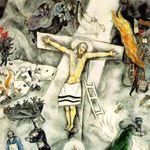
 Jesus Christ suffers in the passion of Israel. In striking Israel, the anti-Semites strike him, insult him and spit on him. To persecute the house of Israel is to persecute Christ, not in his mystical body as when the Church is persecuted, but in his fleshly lineage and in his forgetful people whom he ceaselessly loves and calls. In the passion of Israel, Christ suffers and acts as the shepherd of Zion and the Messiah of Israel, in order gradually to conform his people to him.
 If we wish to grasp the meaning of God's Plan in history with regard to Israel, we must go far beyond the issues relating to the present political Israel or any other temporal vision regarding Israel. We must grasp the role Israel has in God's Plan in the last days of history, wherein we have entered with the end of the time of the nations and the beginning of the time of Israel as God’s nation called in the end times to accept Messiah.
 'To reunite all his children, scattered and led astray by sin, the Father willed to call the whole of humanity together into his Son's Church. The Church is the place where humanity must rediscover its unity and salvation. The Church is "the world reconciled." She is that bark which "in the full sail of the Lord's cross, by the breath of the Holy Spirit, navigates safely in this world." According to another image dear to the Church Fathers, she is prefigured by Noah's ark, which alone saves from the flood.' (CCC 845)
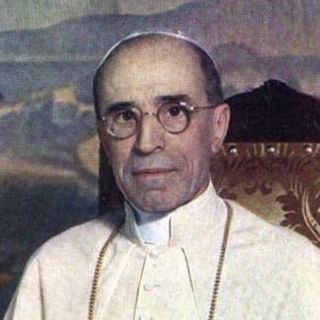 An organization researching the history of Pius XII's relationship with the Jews says that a series of documents recently uncovered show a pattern of direct actions by Archbishop Eugenio Pacelli (the future Pope) that culminated in the establishment of the modern State of Israel.
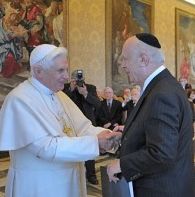 Pope Benedict XVI said any minimization of the Holocaust was unacceptable, especially for a priest, as he met with Jewish leaders in hopes of ending the rancor over a bishop who denied 6 million Jews were killed by the Nazis.
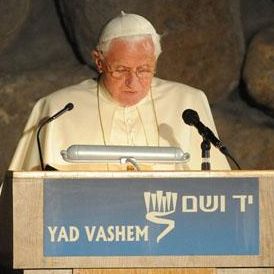 "May the Names of These Victims Never Perish." Here is the text of the address Benedict XVI gave on May 11, 2009 at the Yad Vashem memorial to the victims of the Holocaust.
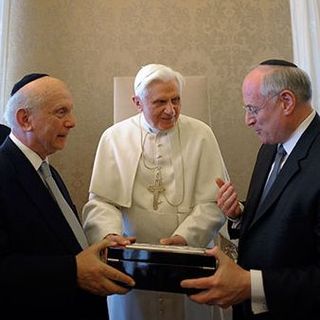 Benedict XVI calls the Shoah "a Crime Against God and Against Humanity" and reaffirms that "the Church draws its sustenance from the root of that good olive tree, the people of Israel, onto which have been grafted the wild olive branches of the Gentiles (cf. Rom 11: 17-24)."
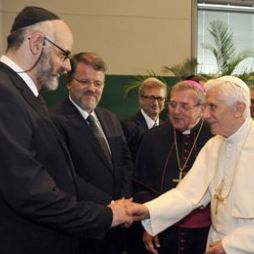 "Strengthen Our Common Hope in God in the Midst of an Increasingly Secularized Society." Here is the address Benedict XVI delivered on September 22, 2011 to a gathering of representatives of the Jewish community at Berlin's Reichstag Building.
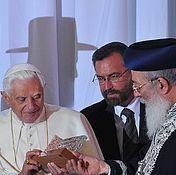 "Our Two Communities Are Challenged to Engage People of Good Will at the Level of Reason." Here is the text of Benedict XVI's address during a courtesy visit to the "Hechal Shlomo" center, seat of the Grand Rabbinate, after he visited the Wailing Wall in Jerusalem.
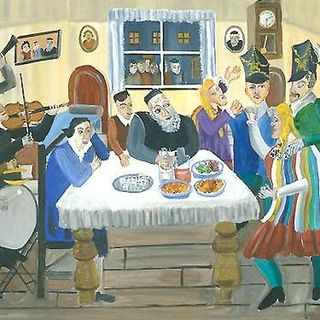 Purim is a day of ecstatic rejoicing, which the Jews celebrate as both a sign of G-d’s enduring love and a promise of their final salvation. There’s nothing in the holiday that contradicts Christian faith, except for one thing: it usually falls out smack in the middle of Lent.
 The history of the relationship between Israel and Christendom is drenched with blood and tears. It is a history of mistrust and hostility, but also - thank God - a history marked again and again by attempts at forgiveness, understanding and mutual acceptance... Can Christian faith, left in its inner power and dignity, not only tolerate Judaism but accept it in its historic mission? Or can it not? Can there be true reconciliation without abandoning the faith, or is reconciliation tied to such abandonment?
 Faced with the "already here" of the Church, Israel is the witness of the "not yet". The Jewish people and the Christian people are thus in a situation of mutual imitation. Christians rejoice in the "already here", while the Jews remember the "not yet".
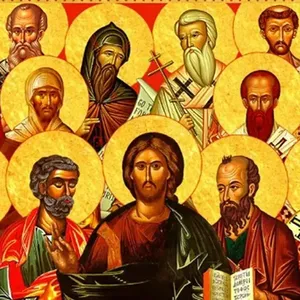 The Church Fathers are often remembered for their hostility toward Judaism. What is less well known is that nearly all of them also expected the Jewish people to be restored — returned not only to faith but, in the expectation of some, to their ancestral land. This article traces that overlooked tradition across more than a millennium of Christian thought.
Cardin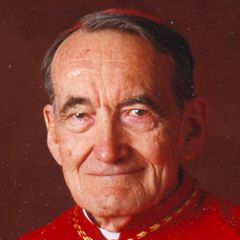 al Avery Dulles (1918-2008), of blessed memory, discusses the present status of God's covenant with Israel, a subject which has been extensively discussed in Jewish-Christian dialogues since the Shoah. Catholics look for an approach that fits in the framework of Catholic doctrine, much of which has been summarized by the Second Vatican Council...
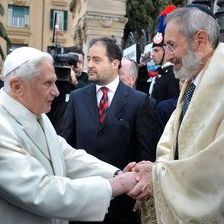 The purpose of my speech is to point out what the change in the relationship between Jews and Christians is about, and especially to show that in this change and in some prophetic events taking place in the world today between Christians and Jews, the heavenly Father is carrying out His plan in history looking more and more towards the day when Christ will return in glory to fulfill the Father's plan upon the world.
The Jewish People and their Sacred Scripturesoffers a comprehensive account of how the Church understands the relationship between the Hebrew Scriptures and the New Testament. It affirms the enduring theological value of the Jewish reading of Scripture, rejects any notion that the Old Testament is obsolete, and highlights the deep continuity between Israel’s Scriptures and Christian faith. The document encourages Catholics to approach Jewish interpretations with respect, recognizing them as a living tradition that can enrich Christian understanding.
