

The article and video below are an expanded version of the previously released article Catholics, Zion, and God's Irrevocable Covenant.
On February 9, 2026, Carrie Prejean Boller—a recent Catholic convert and member of President Trump's Religious Liberty Commission—declared at a congressional hearing on antisemitism that "Catholics do not embrace Zionism." Two days later she was removed from the Commission. The statement went viral. Prejean Boller has since continued to press these claims relentlessly on social media, attracting a large and vocal audience.
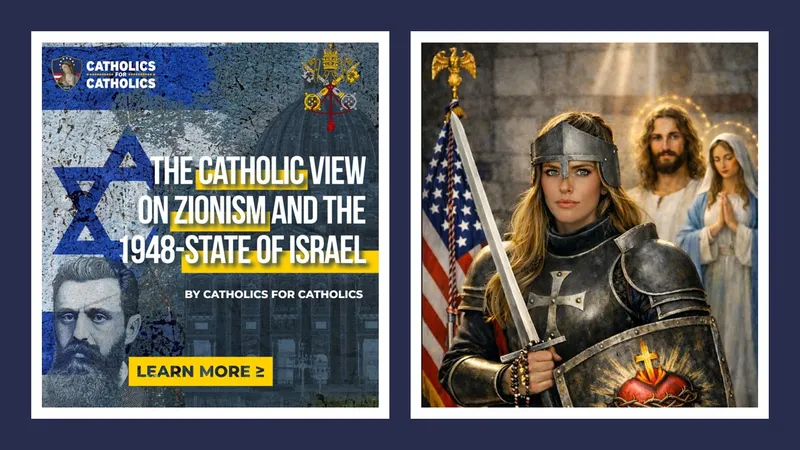
Her remarks were soon given theological reinforcement by a group called "Catholics for Catholics" (CfC), which issued a statement purporting to explain, in their own words, "the Catholic view on Zionism and the 1948 State of Israel." In that statement, CfC asserts that Zionism is "a non-Catholic term that is both biblically charged, and notoriously ambiguous and abused." They insist that Catholics must use "the language of the Church," not "non-Catholic language," to explain what they believe.
CfC concedes that the 1948 State of Israel has a right to exist based on natural law, but "wholeheartedly rejects" the "theological claim" that it is "the inheritor of God's covenant with Abraham according to divine law." They frame the entire debate as a false dilemma: either Catholics affirm Jesus as the sole path to salvation and the Church as the "new Israel," or they fall into "Zionist" error.
CfC further warns that Zionism has legitimized Israel's "domination over the Holy Land" with "bloody and catastrophic" consequences, justified "horrific crimes" against Palestinian Christians, produced "catastrophic foreign policy decisions" by American leaders, and "warped the minds of Christians about their own faith, and deadened their hearts to the plight of their brethren in the Middle East."
So here is the thing: this debate is not new, and it will not end with these voices. The question they are raising is ancient, and it goes to the heart of Catholic theology: Has God revoked His covenant with Israel? Have the promises He made to the Jewish people—including the promise of their land—been dissolved? Is there any room, within authentic Catholic faith, for what we might call a Catholic Zionism?
The views of Prejean Boller and CfC deserve a careful response, not only because they misrepresent both Catholic teaching and Zionism, but also because several Catholic scholars—including Gary Anderson, Gavin D'Costa, and this author, as well as non-Catholics such as Gerald McDermott, have made compelling cases for an authentic Catholic Zionism that owes nothing to Protestant Dispensationalism.
Many Catholics see the work of divine providence in the modern return of the Jewish people to their land. But the disagreement is broader than Zionism alone. On the fundamental questions of God's covenant with Israel, the enduring vocation of the Jewish people, and the proper reading of Scripture, CfC and Carrie Prejean Boller do not speak for Catholics. Here are ten reasons why.
1. "Zion" is a biblical word before it is a political one
CfC dismisses Zionism as a "non-Catholic term"—yet "Zion" appears some 177 times in Scripture. It is not a modern political coinage. It is the language of the Psalms, the Prophets, and the New Testament. Throughout the Bible, the Lord declares his love for Zion:
"For the Lord has chosen Zion; he has desired it for his habitation: "This is my resting place for ever; here I will dwell, for I have desired it."" (Ps 132:13–14)
If God chose Zion as his eternal dwelling, persistently promising to dwell among his people there, then in a very real sense, it is God himself who is the original Zionist. To call Zionism "non-Catholic" is, at minimum, to call God's own language non-Catholic. The New Testament does expand the notion of Zion to include a heavenly dimension (Heb 12:22)—but expansion is not cancellation. The earthly promises are not erased by their heavenly fulfillment.
2. God's promises to Israel include the land—and these promises still matter
God's love for Zion goes hand in hand with hundreds of Old Testament passages in which he gives the land of Canaan to Israel and promises to return them there after exile (Jer 30:3; Ezek 36–37). Many of these prophecies were not fully realized after the return from Babylon. CfC's complete silence on the Old Testament is telling—it reflects a kind of mild Marcionism, the tendency condemned as heresy in the early Church to treat the Old Testament as theologically superseded and its promises as no longer binding. It is a tendency to leave most of the Scriptures behind when they become theologically inconvenient.
3. Not all biblical promises are fulfilled in Christ and the Church
Supersessionists often argue that all Old Testament promises were fulfilled in Christ and the Church. But this cannot be sustained. Some promises clearly await eschatological fulfillment - fulfillment at the end of history.
Isaiah foresees a day when "nation shall not lift up sword against nation, neither shall they learn war anymore" (Isa 2:4). Isaiah also foresees that the wolf will dwell with the lamb, and the knowledge of the Lord will cover the earth as the waters cover the sea (Isa 11:6–9). All these—and many more—remain conspicuously unfulfilled - in Christ, in the Church, or anywhere else.
An authentic Catholic reading of the Bible attends to the four senses of Scripture: literal, christological, ecclesial, and eschatological (CCC 115–118). To dismiss or collapse the literal and eschatological senses into a purely spiritual reading is not Catholic exegesis. The promises of Israel's physical ingathering to their ancestral land have not been fulfilled in Christ or the Church, and their open horizon leaves ample room for Catholic Zionism.
4. Jesus and the apostles affirm the enduring vocation of Israel
Jesus himself never abolishes the Law and the Prophets—he says so explicitly in the Sermon on the Mount (Matt 5:17)—and this includes the land promises. In Luke 21:24, he speaks of Jerusalem being "trampled underfoot by the Gentiles, until the times of the Gentiles are fulfilled" - implying a reversal when Jewish sovereignty will be restored over Jerusalem. In Acts 1, when the apostles ask whether he will "restore the kingdom to Israel," Jesus does not correct the premise of their question. He redirects their concern to timing - but the expectation of Israel's restoration stands.
And then there is Saint Paul's unambiguous declaration in Romans 11:29: "The gifts and the calling of God are irrevocable." This is not a peripheral text. It is the theological linchpin of the entire question. Probably the primary gift of God to Israel in Scripture is the land—and it too, has not been revoked.
5. Supersessionism—the idea that the Church replaces Israel—is not Catholic doctrine
CfC's position essentially reprises classic supersessionism—the view that God's promises to Israel were dissolved and absorbed in the Church. This was a widespread assumption for centuries. But it never became authoritative doctrine - and it was decisively repudiated at the Second Vatican Council.
In Nostra Aetate, the Council explicitly affirmed Paul's teaching: that the gifts and the calling of God are irrevocable, and that God has not rejected his people. This is no small matter. If God's covenant with Israel can be revoked, then the reliability of God's covenant with the Church is also called into question. The same God who made promises to Israel made promises to us Catholics, and he remains faithful to his promises.
6. The Church is grafted onto Israel, not substituted for her
The phrase "new Israel" has some precedent in Catholic tradition, but it does not appear in Scripture - and it has been largely set aside in recent magisterial statements, precisely because it implies that God has rejected Israel and replaced her with the Church.
Saint Paul's own image is not replacement but grafting (Rom 11:17). Gentile believers are the wild branches; Israel remains the cultivated olive tree into which they have been received. Paul's warning to the Gentiles is pointed: "It is not you that support the root, but the root that supports you." The Church humbly participates in Israel's calling and vocation to be a light to the nations - she does not appropriate it or erase it.
7. Saints and theologians have expected a future return of the Jewish people
CfC presents its supersessionist position as obviously and uncontroversially Catholic. But several Church Fathers and scholastic theologians anticipated a Jewish return to the land. Saint Justin Martyr (First Apology 52), the Venerable Bede (Commentary on Luke 21:24), and Saint Thomas Aquinas (Commentary on Jeremiah 31:37) each offered reasons, from within the Catholic tradition, to expect such a restoration.
CfC's sweeping dismissal of Zionism as "not Catholic" rides roughshod over this patristic and scholastic testimony. The tradition is not as monolithic as they imply.
8. The Magisterium leaves room for a moderate Catholic Zionism
The Church's own magisterial trajectory since Nostra Aetate reveals a prudent but increasing openness to the theological significance of the Jewish return to the Land of Israel.
The 1985 Vatican Notes on the Correct Way to Present Jews and Judaism states that the permanence of Israel is to be perceived as "a historic fact and a sign to be interpreted within God's design." Pope Benedict XVI, while cautious about identifying the State of Israel as a direct fulfillment of biblical prophecy, said that its founding nevertheless reflected "the faithfulness of God to the people of Israel."
A moderate Catholic Zionism—one that acknowledges the secular character of the state while recognizing God's faithfulness to Israel in their return from exile—is fully compatible with these ecclesial statements. Even the Jewish prayer for the State of Israel does not call it the "fulfillment of prophecy," but rather "the initial flowering of our redemption." That is a posture of theological humility we might do well to imitate.
9. Scripture remains the soul of Catholic theology
CfC's dismissal of God's promises to Israel reveals a deeper problem: a flawed approach to divine revelation. By fixating on a non-authoritative, now-repudiated supersessionist legacy while ignoring both the plain testimony of Scripture and the current trajectory of the Magisterium, CfC inverts the proper Catholic ordering of Scripture and Tradition.
Catholics read Scripture through the lens of Sacred Tradition and the teachings of the Magisterium—but that teaching office, as Dei Verbum reminds us, "is not above the word of God but serves it" (Dei Verbum 9). Scripture remains, in the words of the same document, "the soul of sacred theology" (DV 24). All of Scripture—including its abundant promises to Israel - must remain the primary touchstone of Catholic theology.
10. Catholic Zionism is not the caricature CfC describes
Finally, CfC's critique of Zionism relies on predictable straw men, and Prejean Boller's mischaracterizations—that Zionism is a "war-mongering heresy" and simply "evil"—are not theological arguments. They are rhetorical demonization, and they would be recognized as such if directed at any other group or position. They deserve to be named for what they are: sweeping, unsubstantiated accusations that substitute emotion for argument.
The heresy charge in particular is theologically illiterate. Heresy is a precise term: it means the obstinate denial of a defined dogma of the Church. As Points 5 and 8 of this article have established, no such dogma against Zionism exists. On the contrary, the Church's own magisterial trajectory since Nostra Aetate moves in the opposite direction. To call Catholic Zionism a heresy is not a theological argument—it is an attempt to shut down a legitimate theological conversation by misappropriating the Church's own vocabulary.
Moreover, the central false dilemma - Jesus or Israel - is one no serious Catholic Zionist would recognize. Catholic Zionists do not deny that Jesus Christ is the only Savior. They do not embrace a dual-covenant theology. Nor do they treat the State of Israel as a messianic kingdom to be "worshipped" or "bowed to," as Prejean Boller has suggested.
CfC's charge that Zionism is responsible for the plight of Palestinian Christians is similarly disingenuous—and historically contestable. The principal driver of Christian emigration from the Middle East is well-documented: it is Islamist pressure, not Israeli policy. Christians inside Israel, by contrast, enjoy full religious freedom, legal protection, and civil rights. The growing community of patriotic Aramean, Arabic-speaking Christians in Israel — many of whom proudly serve in the IDF—is a fact that simply does not fit the narrative CfC and Prejean Boller are selling. If they genuinely care about the fate of Christians in the Middle East, that concern should be applied consistently - including to the communities thriving under Israeli sovereignty, and to the far graver threats those communities face elsewhere in the region.
A call to humility before the mystery of Israel
Both Prejean Boller and CfC present themselves as defenders of the Catholic faith—even, at times, as suffering persecution for it. But relentlessly attacking Israel, dismissing God's covenant with the Jewish people, and misrepresenting the Church's own theological tradition is not a defense of the Catholic faith. It is a betrayal of it.
While the topic of Zionism is undoubtedly a controversial one, perhaps "Catholics for Catholics" and Carrie Prejean Boller would better represent Catholics by showing less hubris and more humility before what St. Paul calls the "mystery of Israel"—a mystery that somehow reflects the Church's own mystery, as Nostra Aetate affirms.
Paul warned Gentile believers: "Do not boast over the branches"—the Jewish people—remember it is not you that support the root—of Israel—but the root that supports you… otherwise, you too will be cut off (Romans 11:18, 22). The mystery of Israel is not one to be cavalierly dismissed. It is not a problem to be solved by slotting the Jewish people neatly into a supersessionist framework and moving on. It is a mystery to be explored with reverence and awe. That is a posture neither Carrie Prejean Boller nor "Catholics for Catholics" has yet shown.