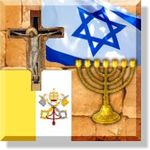
What Do We Mean by "Catholics for Israel"?
Catholics for Israel is an apostolate faithful to the Magisterium—the living teaching office of the Church, to whom Christ entrusted the authentic interpretation of the word of God (DV 10). Accordingly, the official teachings of the Catholic Church—especially Nostra Aetate §4 and the Catechism of the Catholic Church—form the foundation of our convictions regarding Israel and the Jewish people.
The Church and the Jewish People as Formulated in Nostra Aetate
For the first time in her history, the Catholic Church articulated a comprehensive and positive theological account of Israel and the Jewish people in Nostra Aetate §4, promulgated at the Second Vatican Council in 1965. This landmark declaration affirms:
- the enduring spiritual bond that unites Christians to the Jewish people.
- that the Church received the Old Testament through Israel, the people first chosen by God.
- that the Church "draws sustenance from the root of that well-cultivated olive tree"—Israel—into which the Gentiles have been grafted (Rom 11:17-24).
- that Jesus the Messiah, through his cross, has reconciled Jews and Gentiles, creating in himself "one new humanity" (Eph 2:14-16).
- that to the Jewish people belong "the sonship, the glory, the covenants, the giving of the law, the worship, and the promises; theirs are the patriarchs, and from them comes the Messiah according to the flesh" (Rom 9:4-5).
- that the apostles and the majority of the first disciples were Jews, rooted in Israel's covenantal life.
- that even where the Gospel was not accepted, the Jewish people remain "most dear for the sake of their fathers," for "the gifts and the calling of God are irrevocable" (Rom 11:28-29).
- that Jews and Christians are destined, in God's providence, to worship the Lord together with one voice, anticipating the fullness of reconciliation.
- the importance of mutual respect, understanding, and fraternal dialogue, grounded in shared study and encounter.
- that although certain Jewish authorities pressed for Jesus' death, the blame for His Passion cannot be assigned to all Jews then living, nor to Jews today.
- that Jews must never be portrayed as rejected or accursed by God, for such claims contradict both Scripture and the Church's teaching; therefore the Church "decries hatred, persecutions, and all forms of antisemitism directed against Jews at any time and by anyone."
- that the Church remains charged with proclaiming the cross of Christ as the universal sign of God's love and the source of every grace.
Open Questions
While Nostra Aetate provides an essential foundation for a renewed Catholic theology of Israel, it intentionally offers only the most basic elements of that foundation. Many important questions remain open for deeper theological reflection and pastoral discernment. Among them:
- Given that "the gifts and the calling of God are irrevocable" (Rom 11:29), and that a majority of the Jewish people have not yet accepted the Gospel, what is Israel's ongoing role in God's plan of salvation after the coming of Jesus the Messiah? How should the Church understand Israel’s vocation in salvation history in light of both the New Testament and the enduring covenant affirmed by the magisterium?
- Since Christ's Great Commission to "preach the gospel to every creature" (Mark 16:15) remains fully in force—and since the Gospel is "the power of God for salvation... for the Jew first and also for the Greek" (Rom 1:16)—how should the Church express her missionary calling toward the Jewish people with respect, sensitivity, and love? What does authentic witness look like today, especially in light of past failures and the Church’s explicit rejection of coercion, proselytism, and contempt?
- How should Jews who encounter Jesus the Messiah and enter the fullness of truth in the Catholic Church continue to live and express their Jewish identity as Catholic Jews? What forms of spiritual, cultural, and liturgical continuity are appropriate and life‑giving within the unity of the Church?
- How should Catholics of Jewish origin relate to the Torah and the observance of its commandments? What is the proper theological and pastoral framework for discerning which elements of Jewish practice may be retained as expressions of identity, heritage, and fidelity to God’s covenantal gifts?
- If God's gifts and calling to Israel are irrevocable, and if the land of Israel is among the central gifts of the covenant—a gift never revoked in the New Testament—what is the significance of the land today? How should Catholics understand the modern return of the Jewish people to the land of their forefathers within the broader horizon of divine providence and salvation history?
Statement of Faith
In light of Nostra Aetate and the open questions outlined above, Catholics for Israel proposes the following statement of faith:
Concerning the Jewish people:
We DO:
- affirm an unconditional love for the Jewish people, our "elder brothers in the faith," recognizing the unique bond that unites the Church to Israel.
- oppose antisemitism in all its forms, including its contemporary manifestations such as ideological anti‑Zionism that denies the legitimacy of Jewish peoplehood or the Jewish connection to the land of Israel.
- call Christians to repentance for all past and present acts, words, and attitudes of antisemitism, contrary to the Gospel and the dignity of the human person.
- affirm the irrevocable and permanent nature of God's covenant with the Jewish people and reject the false teaching of replacement theology (supersessionism), which claims that the Church has supplanted Israel as God's chosen people.
- affirm the Church's faith that Israel's calling, destiny, and salvation are fulfilled only in union with Jesus the Messiah, the King of the Jews, who was sent first "to the lost sheep of the house of Israel" (Matt 15:24) and wept over Jerusalem's rejection of Him (Luke 19:41). This union with Christ is brought to its fullness within the Catholic Church.
- affirm, therefore, the permanence of the Church's missionary mandate, divinely instituted, to propose the Gospel of salvation "to the Jew first," always with reverence, humility, and love.
- reject the false teaching of dual-covenant theology, which claims that Jews attain salvation through the Old Covenant and observance of the Torah while Gentiles are saved through Christ. While "the Torah is holy, and the commandment holy and just and good" (Rom 7:12), it remains true that "a person is not justified by the works of the Torah [law] but through faith in Jesus Christ… for by the works of the Torah no flesh shall be justified… for if righteousness comes through the Torah, then Christ died in vain" (Gal 2:16, 21).
- affirm that the Church is "the all-embracing means of salvation" in which "the fullness of the means of salvation subsists" (UR 3), and therefore "Church and Judaism cannot be seen as two parallel ways of salvation and the Church must witness to Christ as the Redeemer for all" (NJJ I.7).
- affirm the need for a Jewish-Catholic community in which Catholics of Jewish origin can live a fully Catholic life while remaining faithful to the Torah and to Israel's cultural and religious heritage, in continuity with the first community of Jewish believers who were "all zealous for the Torah" (Acts 21:20). For Jesus did not come to abolish the Law or the Prophets, but to fulfill them (Matt 5:17-20).
We do NOT:
- pretend to love the Jewish people or support Israel as a covert strategy for missionary activity.
- favor disrespectful, manipulative, or aggressive proselytizing toward the Jewish people, which contradicts both charity and the Church’s teaching on religious freedom.
Concerning the Land and People of Israel:
We DO:
- affirm that God's promise of the land of Israel to the descendants of Abraham, Isaac, and Jacob has never been revoked by Jesus or by the New Covenant, and that this promise retains theological significance today.
- affirm that the modern return of the Jewish people to the land of Israel bears prophetic and providential significance, and therefore uphold the theological plausibility of a moderate biblical Zionism, consistent with the Catholic faith.
- affirm that although the modern State of Israel is a secular political entity, its re-establishment may be understood as a possible "first fruits" or initial stage of God's ongoing work of redemption in the life of the Jewish people.
- affirm the right of the State of Israel to defend its citizens against acts of terrorism and violence, while also insisting that such defense be exercised with moral restraint and with the utmost care to avoid harm to innocent civilians.
- encourage and promote reconciliation, peace, and justice for all who dwell in the Holy Land today, recognizing the dignity of every human person created in the image of God.
- call all citizens of the land—Israelis and Palestinians—to repentance, turning away from the grave moral evils that afflict both societies, including hatred and violence, corruption and dishonesty, discrimination and injustice, promiscuity, prostitution, pornography, abortion, and the ideologies that distort human sexuality and the family, and responding to the Lord's call to "be holy, for I the Lord your God am holy" (Lev 19:2).
- call all inhabitants of the Holy Land—Jews, Christians, and Muslims—to embrace the Gospel of Jesus the Messiah, the Prince of Peace, in whom alone are found forgiveness, reconciliation with God and neighbor, and eternal life.
- call all Christians in the Holy Land to greater faithfulness, unity, and witness, living and proclaiming the Gospel of Jesus the Messiah with integrity and love.
We do NOT:
- attribute a definitive or Messianic fulfillment to the modern State of Israel in its present political form.
- advocate for the rebuilding of the Temple or the restoration of animal sacrifices, which have found their fulfillment in the once-for-all sacrifice of Christ.
- support apocalyptic or political movements that promote the ingathering of the Jewish people to the land for the purpose of triggering an eschatological conflict such as the battle of Armageddon.
- necessarily endorse every political or military action undertaken by the government of Israel, recognizing that no earthly state is above moral evaluation.
- support any form of injustice or discrimination toward any person or community.
- harbor or tolerate anti-Arab or anti-Palestinian attitudes, affirming instead the equal dignity of all peoples of the region.
See also: Why Catholics for Israel?